
UMass Lowell business students discuss proposals to increase membership and strengthen workforce development opportunities with staff from the Boys and Girls Club of Greater Lowell. (Photo: Edward Brennen for UMass Lowell)
LOWELL – UMass Lowell has been recertified for the Carnegie Community Engagement Classification, reaffirming the university’s long-standing commitment to mutually beneficial partnerships. The designation was announced this month by the American Council on Education (ACE) and the Carnegie Foundation for the Advancement of Teaching and extends UMass Lowell’s classification through 2032.
UMass Lowell first received the Carnegie Community Engagement Classification in 2008 and has successfully completed multiple recertification cycles. The 2026 classification recognizes institutions that demonstrate deep alignment among mission, leadership, culture, resources and practices supporting community engagement. UMass Lowell is one of 277 institutions nationwide that currently hold the designation.
“Community engagement is not just an initiative at UMass Lowell, it is central to who we are,” said Chancellor Julie Chen. “Our teaching, research and partnerships are intentionally aligned with community-identified needs because we believe a thriving university and a thriving community are inextricably linked. This Carnegie recertification affirms the depth of our commitment to partnerships that create meaningful impact for our students, the City of Lowell and the broader region.”

The Carnegie classification is the leading framework for assessing and recognizing community engagement in U.S. higher education. The elective classification is awarded following a rigorous institutional self-study and peer review process.
UMass Lowell’s recertification reflects the depth and maturity of its community engagement, demonstrated through partnerships that integrate teaching, research, workforce development and public service.
 A cornerstone of this work is education and workforce pipeline development. Through partnerships with local school districts, community colleges and employers, UMass Lowell supports educator pathways and career-connected learning that enable students and paraprofessionals to advance into high-need professions within their own communities.
Community-engaged research and innovation further distinguish the university’s approach. Initiatives in engineering, science, public health and social sciences engage municipalities, state agencies and residents to address pressing regional challenges.
A community-based drinking water monitoring project, for example, empowers residents as “citizen scientists” while producing data that informs infrastructure decisions, environmental sustainability and public health protections.
 Place-based engagement remains central to the university’s mission. Programs such as the Tsongas Industrial History Center and community archives initiatives preserve and interpret the region’s industrial and cultural heritage, serving thousands of K–12 students annually.
Student leadership and creative practice further strengthen this ecosystem. Through applied learning, student organizations and interdisciplinary projects in business, the arts, and global and civic engagement, students collaborate with community partners while developing professional, leadership and public service skills.
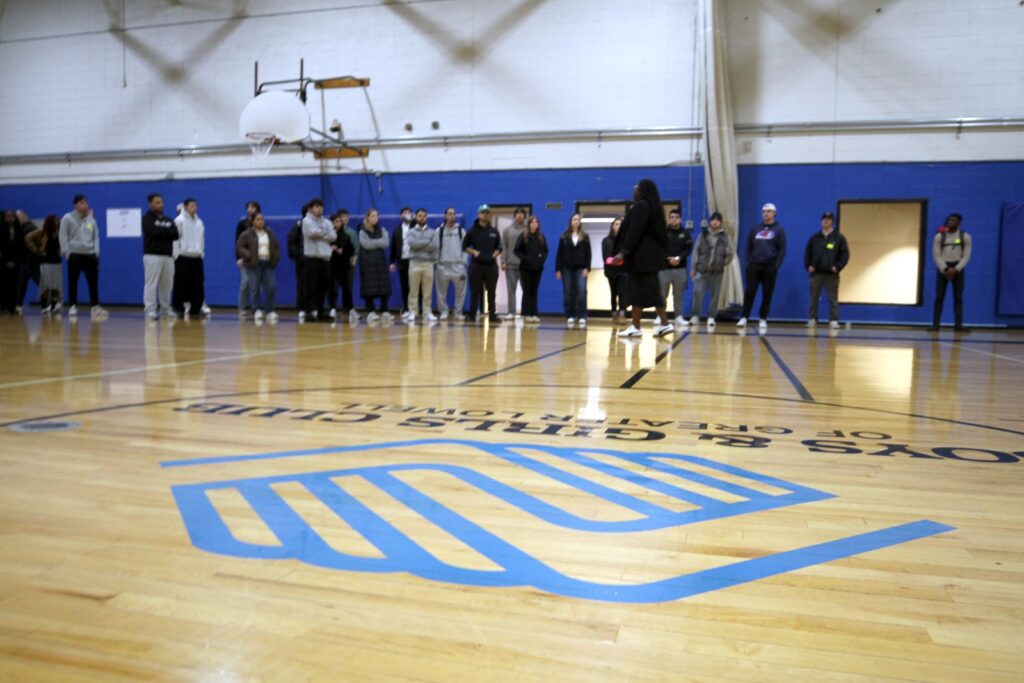
UMass Lowell business students tour the gymnasium at the Boys and Girls Club of Greater Lowell. (Photo: Edward Brennen for UMass Lowell)