 Lowell – The Massachusetts Department of Public Health (MDPH) announced on Wednesday, September 9, 2026, that West Nile Virus (WNV) has been detected in two (2) mosquitoes collected from Lowell, Massachusetts.
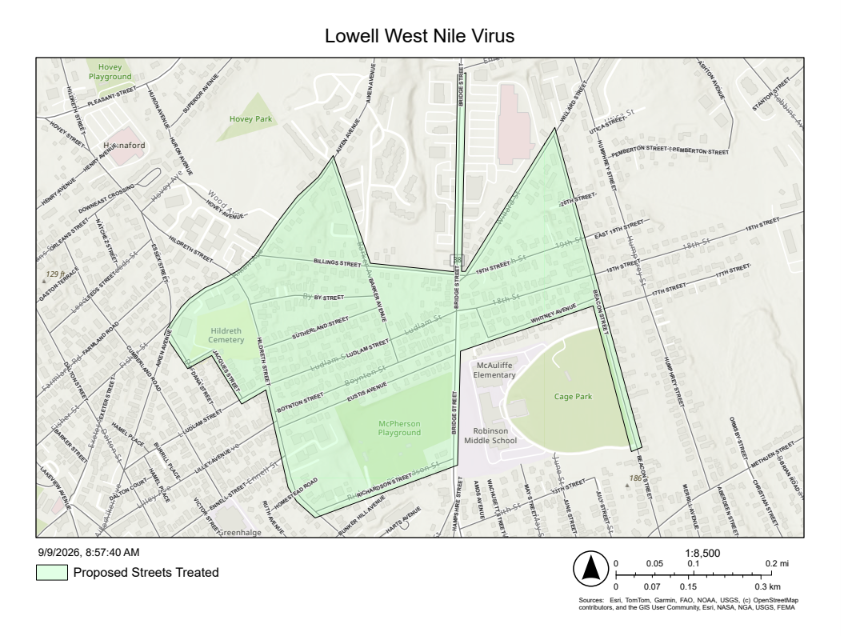
(Map of spray area published in larger form at end of article)
WNV is most commonly transmitted to humans by the bite of an infected mosquito. The mosquitoes that carry this virus are common throughout the state and are found in urban as well as more rural areas. While WNV can infect people of all ages, people over the age of 50 are at higher risk for severe infection.

By taking a few common sense precautions, people can help protect themselves and their loved ones:
AVOID MOSQUITO BITES
- Apply Insect Repellentwhen you go outdoors. Use a repellent with DEET (N, N-diethyl-m-toluamide), permethrin, picaridin (KBR 3023), IR3535 or oil of lemon eucalyptus [p-methane 3, 8-diol (PMD)] according to the instructions on the product label. DEET products should not be used on infants under two months of age and should be used in concentrations of 30% or less on older children. Oil of lemon eucalyptus should not be used on children under three years of age. Permethrin products are intended for use on items such as clothing, shoes, bed nets and camping gear and should not be applied to skin.
- Clothing Can Helpreduce mosquito bites. Although it may be difficult to do when it’s hot, wearing long-sleeves, long pants and socks when outdoors will help keep mosquitoes away from your skin.
- Be Aware of Peak Mosquito Hours– The hours from dusk to dawn are peak biting times for many mosquitoes. When risk is increased, consider rescheduling outdoor activities that occur during evening or early morning. If you are outdoors at any time and notice mosquitoes around you, take steps to avoid being bitten by moving indoors, covering up and/or wearing repellant.

MOSQUITO-PROOF YOUR HOME
- Drain Standing Water– Many mosquitoes lay their eggs in standing water. Limit the number of places around your home for mosquitoes to breed by either draining or getting rid of items that hold water. Check rain gutters and drains. Empty any unused flowerpots and wading pools and change water in birdbaths frequently.
- Install or Repair Screens– Some mosquitoes like to come indoors. Keep them outside by having tightly-fitting screens on all your windows and doors.

While the Health Department continues to work closely with the MDPH and other agencies, locally the City will request that the CMMPC conduct street level spraying within the neighborhood the mosquitoes were discovered on September 10, 2026, during the 8:00PM-11:00PM hours. The affected streets are listed below. Additional information may be provided at www.lowellma.gov and/or www.CMMCP.org websites.
Street Name
18th St
19th St
20th St
Aiken Ave
Barker Ave
Beacon St
Billings St
Boynton St
Bridge St
By St
Dana St
Eustis Ave
Hildreth St
Jacques St
Ludlam St
Richardson St
Whitney Ave
Willard St

Residents in the spray area should:
- Close street-facing windows and keep pets indoors between sunset and midnight, if possible
- Remain indoors during spraying and for 15-20 minutes afterward
- Turn off “outside air” controls on older window-unit air conditioners
- Wash garden vegetables before eating them

There is no need for special precautions the day after spraying, as any residue will have evaporated.
Information about WNV and reports of current and historical WNV virus activity in Massachusetts can be found on the MDPH website at: www.mass.gov/dph/mosquito