
 by Dr. Anne Mulhern
Several years ago, the rules of Lowell City Council and School Board elections were changed. The new rules were first used in 2021, in 2023, and again this year.
The new system changed the dynamics of municipal elections dramatically. For one thing, it made the old mid-term replacement rule a complete disenfranchisement of voters, even more so if the councilor to be replaced were a District Councilor. Thankfully that problem has been at least partially addressed by the state legislature.
I believe that the change will also make election recounts far more frequent both because close-run races will be more obvious and more likely in District elections, and because the cost and complexity of doing a recount for a District election will be much reduced.
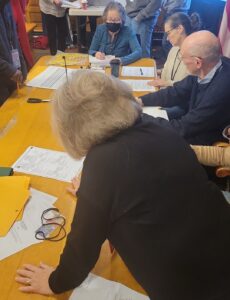
I attended the proceedings for the recent District 3 election recount that were held November 21. Even though District 3 has consistently the highest turnout of Lowell’s eight electoral districts, the proceedings, which began at around 12:30 PM were concluded by around 3:30 PM. Some districts have half the turnout of District 3; recounts for those would be done all that much more quickly.
 Recounts for District elections are so much more manageable because there are fewer ballots for a single district than the whole city and because Lowell District elections are run like tournaments, not like races. The finals are a single combat between just two adversaries. A recount need not involve all the extra tasks that poll workers need to do when closing the polls; it just involves determining which of just two candidates was selected on each particular ballot. Even with one representative of each candidate hovering over the shoulder of everyone doing the actual work of the recount, that is a straightforward task.
Take a look below at the graph of Lowell City Council District Elections.

This depicts the amount by which the winner beat the loser in all contested District elections. A value near zero indicates a near perfect tie, as in the recent District 3 election. A high value indicates that the voters in that district showed an overwhelming preference for one of the two candidates; at the extreme top of the graph, we see that in 2023 Robinson received almost four times as many votes as his opponent in the District 2 election.
 Robinson has had the most consistent and strongest showing of any district candidate. He won strongly in 2021, even more strongly in 2023, and ran uncontested in 2025. Scott has also shown a consistently strong, consistently improving performance.
But the Lowell electorate can be volatile. Jenness had a very strong showing in 2023 in District 4, receiving over three times as many votes as his opponent. Two years later he lost, by a small fraction, to a new contender.
With such a small population of voters per district, there is going to be lot of variation between one election and the next, and within elections between one district and the next. Another near thing, like this recent District 3 election, is likely to turn up sooner rather than later.
This recent District 3 election is not the first really close election in the recent past; in 2019 the results were even closer. Take a look below at the graph labelled Lowell City Council Election 2019.
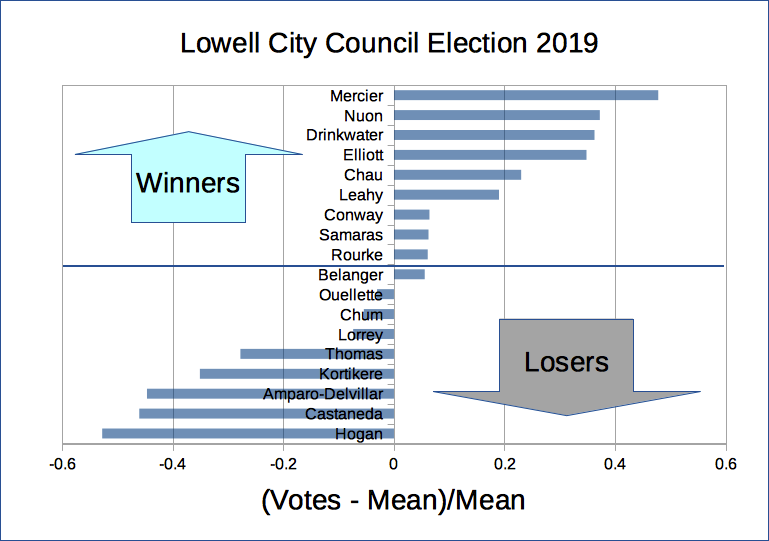
The 2019 election was the last election run under the old system. The numbers show how much the candidate was above or below the number of votes they would have received if all the votes cast had been divided equally among all the candidates, so that all candidates tied.
If the candidate has a positive score, then we can infer that the citizens of Lowell were expressing some preference for that candidate; if a negative one, then the citizens of Lowell did not want that candidate to represent them, overall.
 In this graph, Belanger occupies a very special place; while the citizens of Lowell expressed a lukewarm preference for him as can be seen by his positive value, he was the top ranked loser, tenth among all the candidates. The difference between Belanger and the lowest ranked winner was a mere 19 votes, just one half of 1% of the votes decided for Belanger, even less, proportionally, than the difference in the recent District 3 election.
I do not believe that Belanger requested a recount, although I believe he was entitled to do so. This was a good thing for the City of Lowell Election Office because, in order to be fair and correct, that recount would have had to check every ballot cast in the entire city-wide election and the check would have had to take into account more than just the votes for Belanger. In every way it would have been logistically challenging and would have required multiple days with all the attendant difficulties involved with making sure the ballots remained secure during the recount.
Now that City Council General Elections are less cluttered with candidates than formerly, the probability of such a close result in the General Election is much reduced. If it ever happens and a recount is called for, the recount will be slightly more manageable than it would have been in 2019, but still a serious logistical challenge. Let’s hope it never happens, for the Elections Office’s sake as well as our own.