
by William Lefebvre and Mikaela Hondros-McCarthy
Disclaimer: We are writing this article as Lowell residents, not as a representatives of the Lowell Sustainability Council. Our views are our own and not those of the LSC.

Current Request– additional 96,700 gallons of on-site fuel storage
Three months after their last approval Markley is back before the Lowell City Council with a petition for another fuel storage license amendment. The request will be for the City to approve on-site storage of 96,700 additional gallons of diesel fuel.

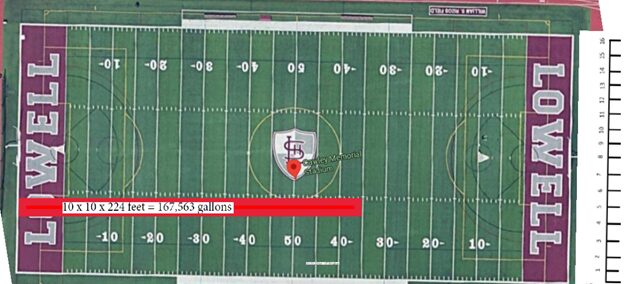
This is a much bigger ask than the 24,000 gallons approved at the June 24th meeting. It is more than double the 71,100 gallons they are currently approved for, bringing the total up to 167,800 gallons. That would be the equivalent of a 10 ft wide by 10 ft tall by 224 ft long storage container, which is a bit taller and wider than a standard shipping container and roughly 2/3 the length of a football field. 167,800 gallons of diesel is equivalent to roughly 1714.9 metric tons of carbon dioxide equivalent (MTCO2e), or carbon sequestered by 29,000 tree seedlings grown for 10 years.
For reference, below in red is a very rough image of what a 10-ft tall fuel tank storing 167,000 gallons would look like overlaid over Cawley Stadium.
Outcome of the last request to the City Council
At the City Council meeting on June 24, the room was filled with Markley employees in red shirts as well as neighbors and advocates voicing their concerns. Councilor Scott motioned to table the vote which failed 7-3 with Councilors Gitschier and Robinson in support and Councilor Nuon not in attendance. The Council voted to approve the additional fuel storage with some councilors noting requests to work with the Sustainability Division to ensure sustainability goals are aligned, and for Markley to show progress on concerns from neighbors before returning with future requests.
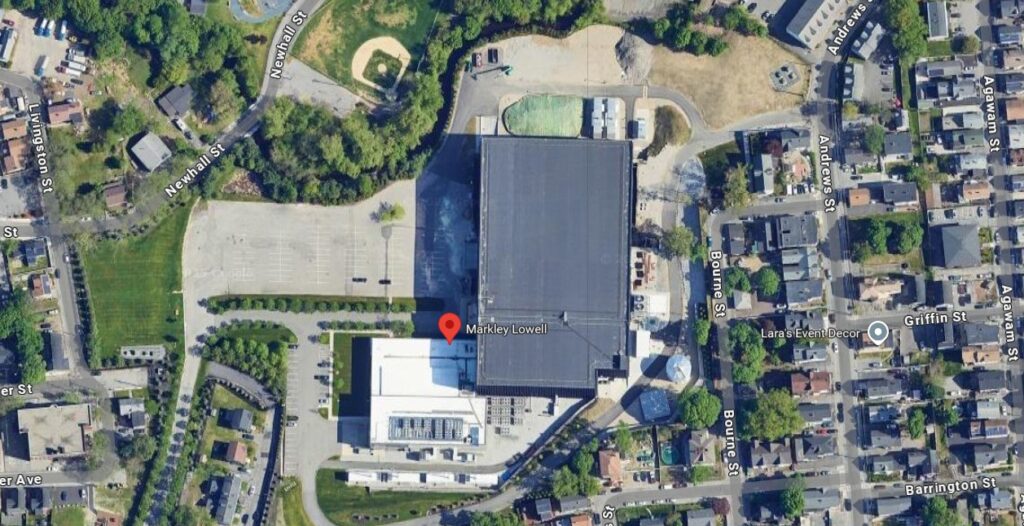
Image courtesy Google Earth
What has happened since?
- Markley has initiated quarterly meetings with the Sustainability Director Katherine Moses. The possibility of adding solar to the roof was discussed but not deemed feasible since the roof is ten years old.
- A letter was sent to the State and Federal delegations on behalf of the City Council on July 24th to request exploring options to use hydrotreated vegetable oil (HVO) as a way to meet climate goals. Supply issues were noted as barriers to this ever being a feasible or viable option.
- Neighbors say promises not kept: According to abutter Jake Fortes, the much-advertised noise abatement wasn’t voluntary community goodwill — it was required to avoid stricter DEP regulations. He notes that while new engines on the north side received sound attenuation and scrubbers, the four engines closest to his home have no meaningful mitigation. Smoke stacks there simply raised emissions from his first floor to his second.
- Operational limits: DEP cut allowable run hours for engines from 100 to 70 annually because of the number of generators on site. Fortes emphasizes this was a regulatory constraint, not a Markley initiative.
- Broken communication promises: Neighbors were promised notice before generator burns or maintenance. Fortes reports they’ve only ever been notified once — before COVID — and that since then, generators have been run for weekly tests, yearly maintenance, and electrical work without warning. As recently as September 6th and subsequent weekends, engines were run with no community notification, despite repeated commitments.
General Pros and Cons of the Markley data center in Lowell
Markley benefits by being located in Lowell, so it would make sense that they would want to continue operations at their current location due to proximity to customers.
- On their website, they market that they have three separate “dark fiber” routes to its Boston data center. Dark fiber means unused fiber‑optic cable they can operate themselves, giving faster speeds, privacy, and redundancy. Having three diverse paths means if one line is cut, the others keep traffic flowing. This is marketed as a reliability advantage for hospitals, universities, and other clients.
- Markley also received a 20-year property tax break valued at about $77 million from the city when they began operations.
Lowell has benefited from having Markley here, too.
- They cleaned up the 14-acre site in 2015
- They have provided roughly 40-50 local jobs
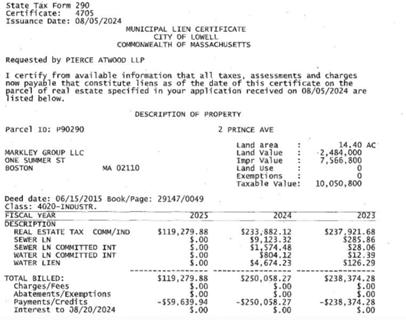
- They pay annual real estate taxes ($233k in 2024, see below).
- They attract high-tech companies. The LINC project may not have happened without a data center being here. Economic development, innovation, etc. etc. Not bad things.

Public health concerns
A drawback to Markley being in such a densely populated area are the effects on abutters. Neighbors have been raising issues about air pollution, noise, health risks, dirt runoff, and poor engagement and communication for years. Markley is also adjacent to a school and a playground. A June 2025 letter highlighting those concerns was submitted to the MA Department of Environmental Protection.
Neighbors next to the facility have also noted chronic noise along with diesel emissions from the site. Being an environmental justice community as it is, the neighborhood that surrounds the data center is already at a disadvantage.
In an urban area like Lowell, heavy reliance on diesel generators can be dangerous. These units release significant particulate pollution and NOx when running, which contribute to asthma and other health problems. It is hard to conceive of a scenario where this much diesel fuel would need to be used and if so, it would have serious health consequences.
The City Council’s role
MassDEP has issued permits for Markley, but the regulations around data centers continue to evolve alongside technology and our understanding of their impacts. The City—and especially nearby residents—bear the day‑to‑day risk of hosting large volumes of diesel in a dense neighborhood.
Approving a large additional storage increase without clear, enforceable conditions shifts risk to the community. If the Council considers approval, it can strengthen public protections by conditioning any increase on items such as:
- Documented progress on noise mitigation and operational compliance.
- A transparent neighbor‑relations plan (points of contact, response timelines).
- A fuel‑use and emissions reduction roadmap (e.g., piloting lower‑emission alternatives as feasible).
- Reporting to the Council on progress before any subsequent license requests.
 Markley’s request to more than double permitted diesel storage—arrives before clearly documented progress on key community concerns. Given the scale of the ask and the neighborhood context, the Council can and should insist on tabling this motion until specific, time‑bound conditions around mitigation, transparency, and energy/emissions reporting as a prerequisite for any approval, including the one sought this Tuesday in the interest of establishing a clear understanding of the impacts. Any vote before those are established would be completely backwards and a show of disregard for the well-being of the residents and the city as a whole.
As City Council Candidate Sean McDonough puts it “The city council has an obligation to ensure that the neighborhoods concerns are being addressed and their questions answered. Given Markley’s track record, a 136% increase in diesel storage seems intended to cut the neighborhood out of this process entirely.”
Open questions
Has Markley made progress on remediation of any of the neighbors’ concerns over the summer?
 The neighbors have had to deal with prolonged periods of noise from water chillers, air pollutant emissions from diesel generators, permitting violations, lack of communication, and concerns about Markley being a good neighbor. Markley has said in prior meetings that they invested $6 million in noise remediation. How much of that was to fulfill existing requirements? Have they looked into and remediated the concerns raised at the last meeting?
How much energy are they using?
Energy usage data should be available this fall thanks to the state’s new “Large Building Energy Reporting” Policy as they mentioned in their first quarterly meeting with Lowell’s Sustainability Director, Katherine Moses. Markley is on the “Covered Buildings List” since it is over 20,000 sf and is required by the state beginning this year to report their energy usage. But, DOER will accept partial or incomplete data for Compliance Year 2025 if building owners make a good-faith effort to comply. So TBD on whether Markley will make good on their usage reporting.
Here is a back-of-the-envelope calculation that could very well turn out to be way off, so take this with a grain of salt. Other estimates haven’t been provided, so working with the limited information we have:
- Current capacity of the data center according to Inflect is at 40 MW, with the total plan to be at 50 megawatt capacity
- The estimated usage of 40 MW operating at 50% capacity (this is an estimation, depending on the customers / flexibility, this could have a pretty broad range) = 175,200 MWhs/year
(40 MW * 50% * 8760 hrs/year) = 175,200 MWhs
- Lowell’s total electricity usage per latest available Mass Save data (2023) = 622,000 MWhs/year, so approx. 28% of Lowell’s total electricity usage could be the data center. Note that this excludes gas consumption.

The City Council should seek clarification here:
The math seems off: 71,100 gallons currently support 18 generators. The total plan is for 27 generators.
 So if they only need 9 more generators, and these additional fuel tanks are only to be used to emergencies, why ask for more than double the current fuel storage capacity? The scale of the ask could suggest that they expect more frequent or sustained use.
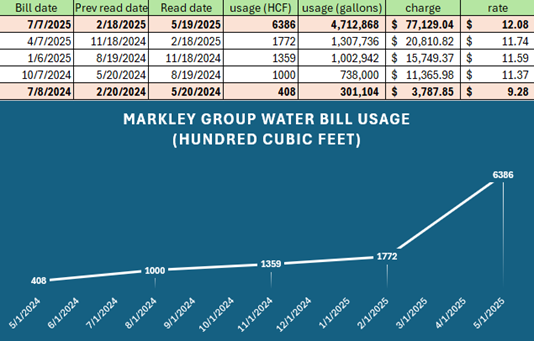
Water usage: from the five most recent water bills, it looks like this latest meter read usage was 15X compared to last year. There could be a totally reasonable explanation for this, but data centers consume a lot of water to keep their servers cool. What would the expansion mean for municipal water usage? And why such a sharp increase from last year?
The Future of Data
In today’s modern world, the need to computing power is necessary, and data centers like Markley are some of the solutions that drive innovation. However, the energy consumption needs, along with the numerous adverse effects of its operation lead to many wanting nothing more than the data center out of their neighborhood. The City of Lowell can lead by example with the Markley Data Center. Being named the first “Frontrunner City” in Urban Transformation by the Urban Economy Forum, the city is poised to sustainably expand the energy needs of buildings like Markley.
 Public support, transparency in data, and effective policy from both the City of Lowell and the Commonwealth are key to protecting citizens from runaway expansion.
4 Solutions Lowell Could Consider
The Future Grid Series hosted by MassCEC & ACT earlier this year outlined practical steps communities can take to balance the benefits and burdens of data centers. Recommendations included:
Cleaner Backup Power: Pilot alternatives like fuel cells or hybrid storage including batteries instead of more diesel.
Community Benefits Agreement: Negotiate formal commitments for neighborhood improvements and abutter protections.
Transparent Reporting: Require real-time energy and water use and emissions data sharing.
Proactive Planning: Build protection plans into every approval so the city stays ahead of impacts, not behind them.
These steps could turn a contentious expansion into an opportunity for Lowell to lead on balancing innovation with community well-being.
Source links:
Future Grid Series Event 1 Report: Balancing Data Center Energy Use & Climate Goals (March 31, 2025) (MassCEC & ACT)
May 7 2025 Markley Project description for DEP (includes generator list)
Markley’s data center expansion approved (Melanie Gilbert, Lowell Sun, October 2024)
Lowell City Council approves Markley Group’s diesel-fueled expansion (Melanie Gilbert, Lowell Sun, June 2025)












6 responses to “Markley Back for More Fuel Storage Approval”
It’s time for change. The current Council is more protective of the corporation than the neighborhoods.
Congratulations, this is a comprehensive and fair look into this issue. Let’s hope the city council fully considers it.
This is the type of research that paints a clear picture of what’s happening. It’d be nice to have one of these people on the city council!
I would like to hear from the councilors running for this district and those running at large, to tell us where they stand on these issues.
And can we get the hospital and university to respond as they are the big users that will be requiring this expansion and I think they both are concerned about how Lowell will be affected.
A very concise report
Thank you
Great article outlining all the pros and cons of the data center let’s hope the councilors read the article and consider the matters/issues you’ve outlined and use the information/data as they move forward
They use 28% of Lowell’s electricity?! That’s wild!! Thank you for this extremely well written and thought provoking article!