
 After years of effort to add another sheet of ice on campus, UMass Lowell is skating a giant stride forward into scoring that goal.
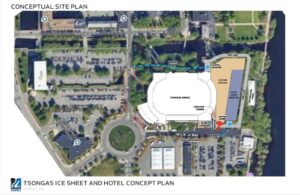
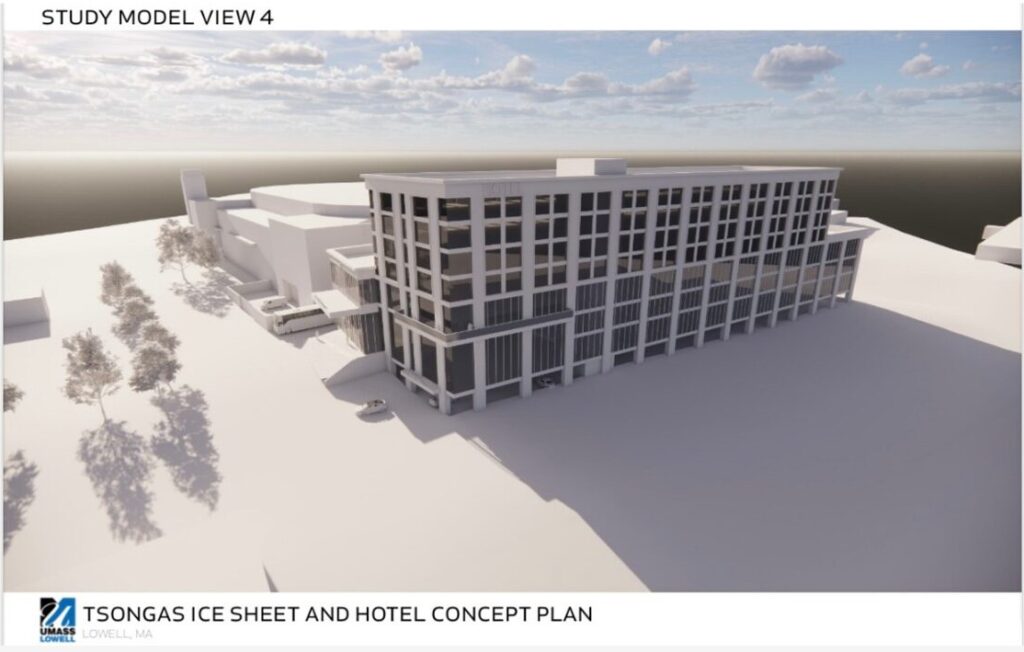
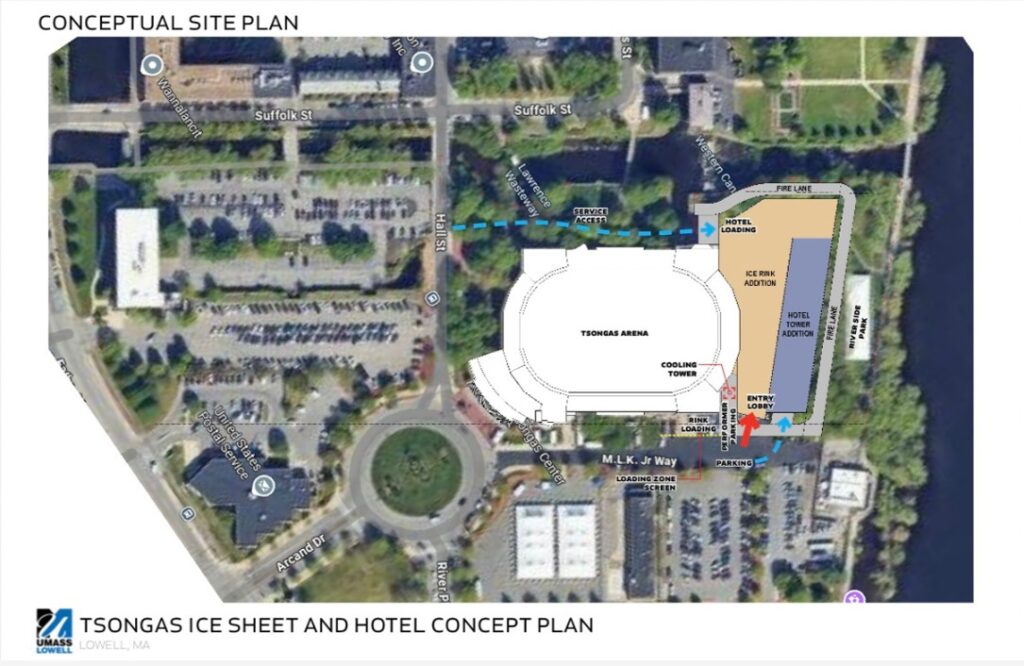
The UMass Board of Trustees voted unanimously Tuesday to allow the Lowell campus to proceed with exploring the possibility of adding a practice rink behind the Tsongas Center, a process that will begin with the issuance of a Request for Proposal (RFP) sometime in early January. In addition to the practice rink, the RFP will also call for the construction of a hotel connecting to the practice rink and the Tsongas Center.
The university’s hope is that the inclusion of a hotel in the project will make the development financially feasible, as UML is not expected to contribute any financing toward the new facilities other than contributing the parcel of land behind the existing arena.

Plans for the hotel, while not yet concrete, target about 120-rooms, meeting space and a function facility. The exact capacity will ultimately be decided by the developer awarded the project.
In other University news, UMass Lowell is also making progress on the Lowell Innovation Network Corridor (LINC), after needing to adjust plans for the commercial component of the project in order to make it financially feasible.
 The adjustment calls for the “Industry Building” to be expanded from the original six story design to an eight story building. The approximately 60,000 square feet of additional commercial space was deemed necessary to make the financial numbers work in today’s construction and rental environment.
UMass Lowell and Wexford, the commercial developer for the LINC project, plan to spend the next six months locking in enough companies to occupy 75% of the Industry Building, which will allow them to proceed with the development and hopefully break ground by the end of summer 2026.
Given the tremendous interest in the already announced LINC development, along with the face Draper Labs plans to construct another commercial building in Lowell Hamilton Canal Innovation District, University officials are confident they will achieve their goal.















10 responses to “Practice Makes Perfect for UML Hockey Rink”
More non taxable University property.
It is disappointing that the precious open space is being absorbed by the practice rink, but somewhat compensated by the hotel.
It’s actually a private development on a plot of land that currently generates zero tax revenue, and converting it into a property that will generate significant tax revenue.
The concerning issue, I think, is the economic news indicating the MA economy is slowing, the federal government’s cuts in biotech spending hurt the Commonwealth, and AI-related projects are enormous energy and water drains and, in many places, have caused utility prices to go up. The contradictory results of the tariffs have also slowed any job growth in manufacturing, so there is likely no help there. As part of this overall effort, the University could focus some of its search for private-sector firms away from defense and into areas like geriatric health care and perhaps collaborations with its neighbor, Mill City Grows, to work on issues like food insecurity. UMass Lowell is a public university, after all.
Having an economic engine like UMass Lowell is a benefit to the city. The hotel will generate taxable revenue, and the existence of a practice rink will allow the Tsongas Arena to be defrosted and set up for concerts, conventions, and indoor fairs – all of which generate revenue for the city and its residents. Let’s hope this gets built, and quickly.
Economic benefit to the city for sure – but the question remains, who benefits? If the hotel, new ice, expanded visitor possibilities are tied to the local economy great. But, if the food, for example, is Aramark and not the dozens of local restaurants all around the arena and ballpark, the benefits are not so great. With this project and the entire Lync effort should come a public body of some sort keeping track of the benefits so that impacts can be determined. With projects this large, there needs to be more than magical thinking to say the city’s residents benefit. Here’s a simple idea: if and when there is a hotel there, the culinary programs at area high schools get involved along with local restaurants, and at least 50% of the jobs are filled by Lowellians.
Oh wait are you talking about percentages of local residents working i think we have spoke on that issue before it’s illegal and a private developer isn’t signing off on a pla and there’s no prevailing wage attributed to any of this nobody said a word when every mill building in the city were rehabbed with workers from new hampshire and every other city and state unless umass or the city implement a pla which umass did for the tsongas for future projects its null n void but again the legality of it’s questionable and whos funds and tax credits etc if any are being used stay tuned
Maybe people check in to a hotel and just eat room service and maybe they go out. But anyone who has attests concert at the Tsongas knows the bars and restaurants are packed before and after, and practice ice will make that possible more often. Having a hotel downtown also opens up opportunities for events and captures revenue from both visitors to the school and to the city. For now, that all goes to neighboring towns. Plus, a hotel next door to an arena allows for conventions and exhibitions. I’m guessing too that the LINC expansion will result in teams and employees traveling to their Lowell offices and needing a place to stay.
As for Aramark, I don’t know what the revenue sharing agreement is with the school for Arena sales but anything that cuts down campus costs is a bonus to the students. Even if the benefit to the city is only incidental, improved reputation and activity tend to decrease criminal activity in an area. Twenty+ years ago the area between East campus gym and the Tsongas arena was less than safe – today, not so much. Much of that can be credited to the University’s expansion and increased activity. But I’m not sure the High School’s should be running things – I’d prefer to see full time employees maybe supplemented with college students who always need some extra money.
So disappointing that they are taking away green space from residents.
On jobs, there could be a commitment to hire local – happens all the time.
There is zero chance that any of this economic development will translate into reduced costs for UMass Lowell students. The ship of making a UMass Lowell education cheaper sailed years ago. An irony of thehistory is that as the University has grown in strength and educational outcomes, it has achieved a kind of recognition on the broader world unheard of thirty years ago. This leads to all sorts of changes inwho applies and is admitted, the percentage of local students who get in, etc. At the same time, the state’s contribution to the costs of running the place shrinks. Greater success requires more funds to sustain it. Tuition goes up accordingly, and slowly but surely, lots of local students willbe priced out. In addition, a large part of the success is in graduate education. Graduate students need places ot live and, as a general rule, do not want to live in dorms. They end up in the city or surrounding towns, which then puts pressure on local housing costs and availability. Running a University is tricky because doing well causes new kinds of headaches! In this instance, UMass Lowell needs to find a way to build some grad student housing.