
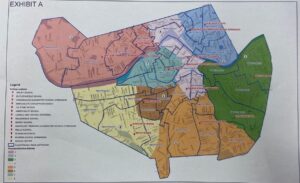
 Last August, we reported on a case before the United States Supreme Court that could impact Lowell’s political landscape. Today, the court ruled in a manner which sent shockwaves throughout the country and might potentially eliminate the Mill City’s two majority-minority districts.
By a 6-3 vote, the Supreme Court limited a key provision of the 1965 Voting Rights Act, striking down a majority Black congressional district in Louisiana. The decision opens the door to further challenges regarding district maps relying heavily on race to create such districts.
A majority-minority district is one drawn in a manner assuring racial minorities make up at least half of the district.

At the time the Supreme Court decided to consider the Louisiana case, Lowell City Solicitor Corey Williams told InsideLowell “our Consent Decree references Section 2 of the Voting Rights Act, along with the Fourteenth and Fifteenth Amendments, so any future decision of the Court will have to be examined in conjunction with the Consent Decree to ensure that Lowell’s districts are compliant with federal law and the U.S. Constitution.”
 The Consent Decree Williams referenced is the settlement in the Huot v. City of Lowell suit filed in 2017, which led to a 2019 settlement establishing a new system of government in Lowell. Under the new system, the City Council and School Committee are elected in a hybrid model featuring district and at-large representatives. Previously, the Mill City’s municipal officials were elected under an all at-large system.
Along with district representation, the settlement established two majority-minority districts, comprised of the Acre and Lower Highlands neighborhoods.
With the Supreme Court decision on Louisiana no longer a hypothetical situation, Solicitor Williams sent us the following statement when contacted this afternoon;
“Today the Supreme Court issued a decision in Louisiana v. Callais et al., 608 U.S. ___ (2026), a voting rights act case involving Louisiana’s congressional map (SB8) and its overall legality under Section 2 of the Voting Rights Act and the Fourteenth Amendment to the U.S. Constitution.
 While Louisiana was pending in the Supreme Court, the justices requested that the Parties brief the following question for review: “Whether the State’s intentional creation of a second majority-minority congressional district violates the Fourteenth or Fifteenth Amendments to the U.S. Constitution.”
The Supreme Court resolved the question posed in its request for supplemental briefing. In Louisiana, the Court voted by a 6-3 decision, with an opinion written by Justice Alito, that “the Voting Rights Act did not require Louisiana to create an additional majority-minority district” and “no compelling interest justified the State’s use of race in creating SB8.”
Today’s decision by SCOTUS directly impacts Lowell, as the City is currently under a consent decree which requires the creation of multiple majority-minority districts under Section 2 of the Voting Rights Act. The specific “impacts” relative to the consent decree are currently being researched and analyzed extensively.
What does this mean for the City moving forward? That answer is TBD, mainly because this issue has not been considered in over 60 years. The Voting Rights Act was enacted in 1965, which means today’s decision is essentially going to be a matter of first impression for the entire country.
The City Administration (Solicitor’s Office, City Manager’s Office, and Elections Office) has already begun the due diligence process and will work closely with the City Council to fully evaluate and understand what today’s decision means for the City of Lowell currently and moving forward. Any potential decision, whether action or inaction, is going to require a combination of legal analysis and policy consideration.”
















4 responses to “Supreme Court Shockwaves to Reach Lowell?”
Hopefully, the City will see the philosophical, equitable side of this and maintain the status quo regardless of the SJ decision.
WOW, so basically the city will need to show or prove that the redistricting was not done solely based on race because if it was, that would be considered reverse discrimination.
But still, the Supreme Court did not strike down Section 2 of the Voting Rights Act and declare it unconstitutional, all it did was set a higher legal bar for its use, meaning you have to really prove intentional discrimination. We all really need to evolve from the past and move forward to a more “color blind” society, I know I always have.
There are enough bigots in Lowell to worry about one (or more?) of them filing a federal lawsuit challenging the the current district alignments. I believe the consent decree (correct me if I’m wrong) actually defines the creation of two majority-minority districts based on minority populations and if I’m correct that specifically violates yesterday’s Supreme Court decision. The City Attorneys need to recognize this as they analyze how the decision affects Lowell and how they will reply to the likely court challenge(s). And we as Lowell citizens need to provide our inputs into the discussion.
Mr. Sweeney, I feel alot more hopeful and optimistic, because I just finished listening to former Lowell City Council Candidate Jose Cervantes on WCAP radio express his feelings about the recent Supreme Court ruling and he seemed VERY complimentary of the city and its administration. Also, the guest that called in, Ms. Lorena Betts who is a candidate for the 16th Middlesex State Representative seat, was also Very complimentary of the city and its administration! It really was GREAT and VERY INFORMATIVE radio! GREAT JOB Jose!