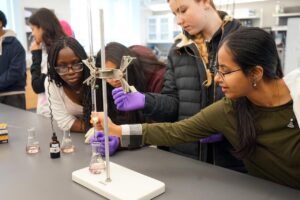
Photo courtesy Edward Brennen for UMass Lowell
LOWELL – UMass Lowell is helping prepare high school and college students for careers in biomedical engineering through the development of a new training laboratory and summer program.
The Massachusetts Life Sciences Center (MLSC) awarded UMass Lowell more than $400,000 through its Education and Workforce Development Grant Program, in which more than $374,000 will go toward a tissue engineering training laboratory on campus and nearly $30,000 will go toward an intensive biomedical summer program hosted by the Tsongas Industrial History Center, an education partnership between UMass Lowell’s School of Education and the National Park Service at Lowell National Historical Park.

“Massachusetts maintains its leadership in the life sciences by investing early in the next generation of talent and ensuring that students have access to state-of-the-art facilities and industry-relevant curricula,” said MLSC President and CEO Kirk Taylor, M.D. “These investments also ensure that low-income, underrepresented and non-traditional learners from every region of Massachusetts, whether located in our Gateway Cities or rural communities, have the skills and opportunities needed to enter and grow within the life sciences workforce.”

The MLSC funding will support the acquisition of essential equipment to outfit a dedicated tissue engineering training laboratory on UMass Lowell’s North Campus. The lab will enhance hands-on training for students in UMass Lowell’s Department of Biomedical Engineering and ultimately strengthen the regional life sciences workforce pipeline by producing graduates who are prepared to enter high-demand roles in biotechnology, pharmaceuticals, medical devices, diagnostics and regenerative medicine.
Assistant Professor Yanfen Li is leading the development of the new facility, alongside Associate Professor Chiara Ghezzi and Teaching Professor Adam St. Jean, all of UMass Lowell’s Department of Biomedical Engineering.

“Biotechnology is a huge sector in Massachusetts, and to succeed in this sector, you need hands-on experience to build certain skill sets,” Li said. “I am so thankful for MLSC’s support because this training lab is going to enrich the students’ educational journeys and make them really competitive for the careers that they want to go into.”
The intensive biomedical summer program will be a week-long experience for high school students in which they will examine historical innovations in combating disease locally and then work alongside UMass Lowell researchers and graduate students in the lab to learn current biomedical engineering skills. Part of the MLSC grant will go toward student stipends to make the program more accessible.
 Li, who is also the assistant director for training for UMass Lowell’s Center for Pathogen Research and Training, is working with the Tsongas Industrial History Center to develop the program. They are also collaborating with Greater Lowell Technical High School, with plans to include additional area high schools.
“The summer program will build a bridge between the history of science and engineering in Lowell and what’s happening today,” said Paul Kuttner, director of the Tsongas Industrial History Center. “It will expose high school students to pathways in biomedical engineering and leave them thinking about how they can be a part of the long history of people who have used science and engineering to address public health.”