
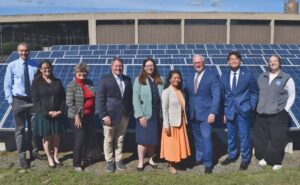
City and state officials stand together in front of a solar array at the Lowell Regional Water Utility. (Photo Courtesy City of Lowell)
LOWELL — The City of Lowell will be able to improve climate and storm resiliency at the Lowell Water Treatment Facility on Pawtucket Boulevard thanks to a $2.5 million grant from the Massachusetts Department of Energy Resources (DOER).
The $2.5 million Advancing Massachusetts Power (AMP) Energy Storage Grant will enable the City to buy a massive industrial battery that can power essential systems at the Water Utility for approximately eight hours in the event of a power outage.
The new battery, which can provide up to 469 kilowatts of power from a battery that stores 4,514 kilowatt-hours of energy, will also be able to recharge itself using an array of solar panels outside the facility.

Extreme weather caused by climate change will strain the electricity grid, so building climate resilience into critical infrastructure such as the City’s water systems is crucial for the future.
The AMP Energy Storage Grant Program will distribute a total of $40.3 million to 29 communities statewide to power critical facilities during outages, provide safety and education training to first responders and local officials, and support two long-duration storage projects that use innovative technologies.

Mayor Erik Gitschier said the solar panel array at the Water Utility has already produced more than 6 million kilowatt-hours of electricity, saving the City more than $300,000 in utility costs.
“This AMP grant will allow us to take the next step by renewing and modernizing this renewable energy system,” he said.
 Rep. Tara Hong, Sen. Vanna Howard, and City Councilor Belinda Juran were in attendance as Energy Resources Commissioner Elizabeth Mahony spoke about the grant program.
City Manager Thomas A. Golden, Jr., singled out Sustainability Director Katherine Moses for helping to secure the grant, and for working in multiple ways to build the City’s climate resiliency, and to support energy ratepayers. Moses has led efforts to bring approximately $32 million in funding to Lowell overall.
Solect Energy will own the new battery system and manage the grant, while the Lowell Water Treatment Plant will be the beneficiary.
Following the presentation outside of the Lowell Regional Water Utility, Chief Utility Officer Aaron Fox led Commissioner Mahony and others on a tour of the water facility.

“This grant represents yet another step in our effort to build a more resilient, reliable and modern City infrastructure,” said City Manager Golden. “I want to thank the Department of Energy Resources for their support, Commissioner Mahony for her thoughtfulness, and all of the hard-working staff who keep this building running just like this battery will.”

“Power outages disrupt vital services communities depend on. We’re thrilled to award the City of Lowell this grant for a battery energy storage system that, along with their existing solar, will help ensure the Greater Lowell community has clean drinking water during outages without adding excess pollution to the air,” said Energy Resources Commissioner Elizabeth Mahony. “The clean energy stored by the battery system will also reduce monthly energy costs and provide added revenue to the City, lowering costs for the residents and businesses served by the Lowell Regional Water Utilities.”
-
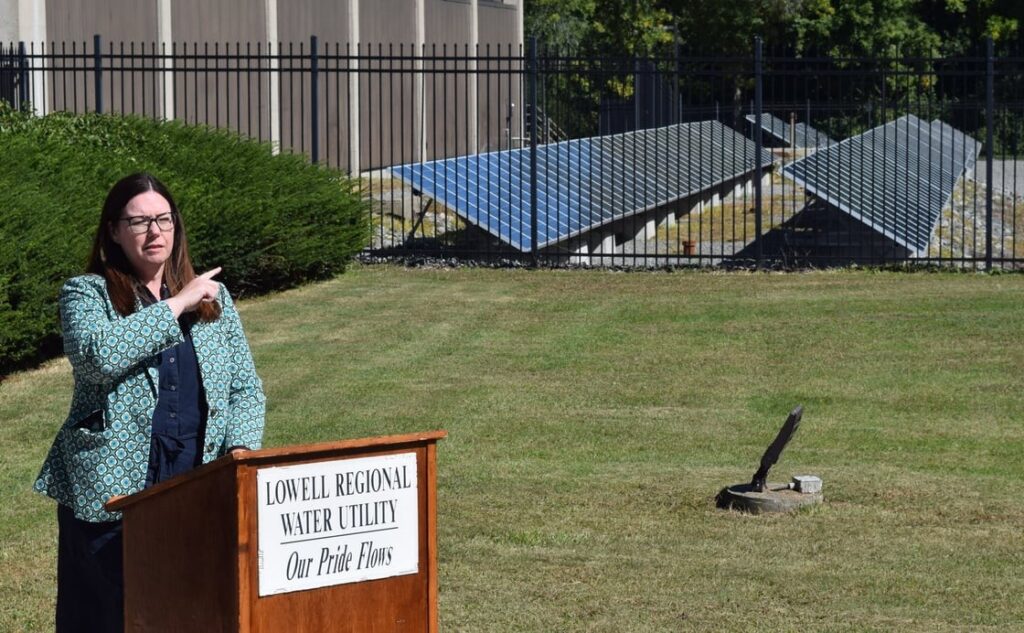
- Commissioner Elizabeth Mahony, of the Massachusetts Department of Energy Resources, gestures toward a solar array at the Lowell Regional Water Utility. (Photo Courtesy City of Lowell)
-
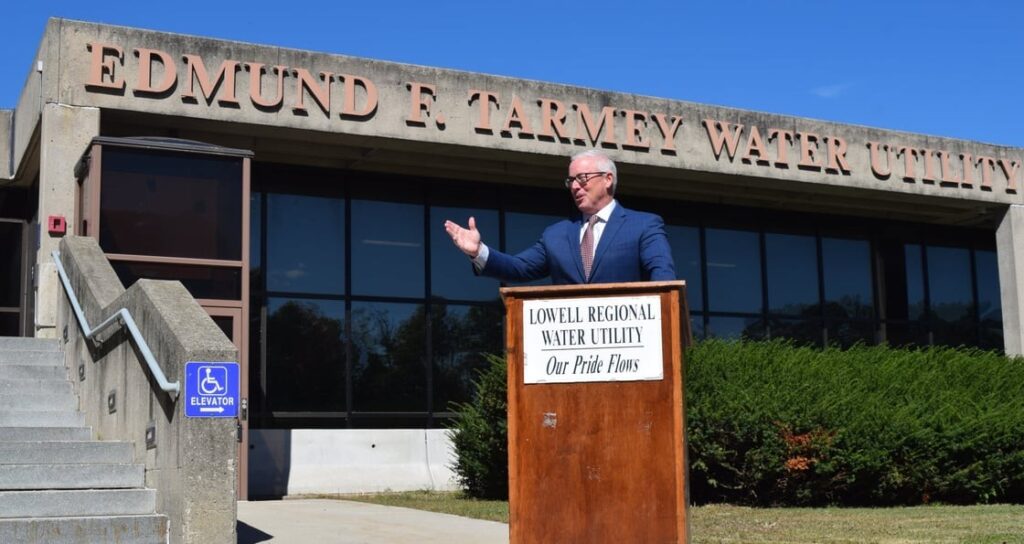
- City Manager Thomas A. Golden, Jr., welcomes Massachusetts Department of Energy Resources Commissioner Elizabeth Mahony to the Lowell Regional Water Utility. (Photo Courtesy City of Lowell)

















12 responses to “City of Lowell Accepts $2.5 Million Grant to Improve Climate Resiliency at Lowell Regional Water Utility”
”lowering costs for the residents and businesses served by the Lowell Regional Water Utilities.” 😂😂😂😂😂
The savings are actual data. The facility’s solar panels already saved Lowell over $300,000. This new $2.5M state grant is 100% state-funded, and not local taxes, plus the system will be completely owned and managed by Solect Energy, meaning ZERO maintenance costs for the city!
By storing solar power to avoid peak grid rates, it lowers the utility’s monthly operating bills while providing 8 hours of emergency backup power. It prevents costly system shutdowns and stabilizes water rates for residents without adding pollution to the air. It’s really just simple and very basic utility math, and not a joke!
KUDOS to ALL!
Will my water bill go down?
Truthfully, it will keep ALL water bills from going higher. Because by using free solar power and the state-funded battery storage, the city doesn’t have to buy expensive commercial electricity from the grid. This lowers the water plant’s operational overhead. By cutting their own energy bills, those savings protect water customers by reducing the need to raise water rates down the road. A win, win, because every little bit helps!
Can’t wait to see my water bill not go up.
Nobody wants to see their bills go up! Mine is overdue! While no utility can completely stop inflation from affecting things like water treatment chemicals or pipe maintenance, cutting the plant’s massive electricity bills means the rates will always be lower and more stable than they would have been without this solar and battery system. Like I said, every little bit helps.
This will have nothing do with keeping our bills down. Your bill doesn’t go down when the price of gas goes down does it? Answer no materials still cost more trucks,aggregates piping. Fittings overtime etc
Which is exactly why my previous post stated that inflation affects materials and maintenance.
However, ignoring a free $2.5 million state grant that directly cuts the plant’s massive electric bills makes zero fiscal sense. When trucks, piping, and aggregates cost more due to inflation, slashing your electricity overhead is exactly how a utility offsets those rising costs to keep consumer rates as stable as possible.
It’s simple and basic cost suppression. Because every bit of savings counts!
Free? Not taxpayer dollars?
It’s a state grant funded through existing “Massachusetts Department of Energy Resources (DOER) programs”.
It did not raise local property taxes, it did not add a new tax to Lowell residents, and it didn’t come out of the city’s municipal operating budget. Lowell is very successfully winning back the state tax money the hardworking taxpayers already paid, instead of letting another town take it!
Utilizing existing state funds to lower the water plant’s operating costs is exactly what VERY smart and VERY wise city management looks like! A complete TEAM effort!
Where do the state funds come from a tree?
Of course not. They come from the state tax pool that EVERYONE in the state, including Lowell residents, already paid into.
Since that pool of money already exists and is going to be spent somewhere, a VERY smart and VERY wise city council and city management TEAM aggressively secured Lowell’s share to lower the water facility’s operating costs, rather than letting it go fund a project in Worcester, Cambridge, or Lawrence.
That’s just VERY smart and VERY wise financial leadership!