
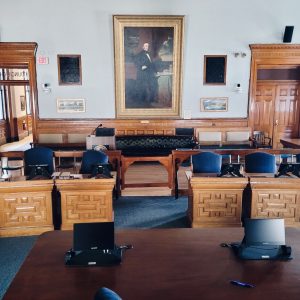
 When the Lowell City Council meets in chambers this coming Tuesday night, two agenda items stand poised as potential flash points that spark fiery debate.
The petition by the Markley Group, requesting the installation of 16 diesel fueled backup generators, follows approval of four such generators in late June. At the time, even councilors in support of the effort spoke of the need to seek more environmentally conscious alternatives, in light of the knowledge Markley would soon be back in front of the floor with a bigger ask.
The rapidly developing Artificial Intelligence (AI) revolution, and the even more rapidly expanding demand for energy to fuel it, have been the focus of a number of Daily Pulse episodes since those June discussions.

Suffice it to say, the Mill City is front and center in a global clash between the plentiful energy needed to fuel the AI race and the Green Energy movement, which yours truly has often predicted will be cast aside even by its traditional political allies due to the need to power AI. (Little did I know that Governor Healey would beat AI to the punch by casting aside environmental concerns in order to build housing)

But the agenda item I believe will draw the most attention when all is said and done is one pitting at least two city councilors against at least one of Lowell’s State Representatives;

The topic of Harm Reduction Centers, also often referred to as Safe Injection Sites or Shooting Galleries depending on which side of the issue you fall on, evolved into a topic on this past Tuesday’s Daily Pulse episode featuring the Lowell Sun’s Melanie Gilbert.
The discussion began with us both questioning the wisdom of needle exchange programs for drug users that allow individuals to return one used needle and receive ten in return, but eventually evolved into a discussion on the wisdom of government sanctioned locations where users would be allowed to inject illegal drugs they’ve previously purchased, under supervision and under the belief it makes it safer to use.
 Little did Melanie and I know at the time we would soon be covering a discussion on the council floor around that exact issue.
When contacted about why the motion was filed, both Councilors Robinson and Gitschier told InsideLowell its genesis lies in Massachusetts House Bill 2196; “An Act Relative to Preventing Overdose Deaths and Increasing Access to Treatment.” 18th Middlesex State Representative Tara Hong (D-Lowell) is a petitioner on the bill.
The Bill’s language includes wording allowing the “supervision of persons who use pre-obtained substances.” In other words, the ability to go purchase illegal drugs somewhere, bring them to a site approved by local or state officials, with supervision from “Harm reduction program operators, entities or individuals directly involved in the operation, administration or staffing of a harm reduction program, including directors, board members, consultants, health care providers, service providers, staff and volunteers.”
The legislation also includes needle exchange programs, though whether the 1-for-1o exchange ratio seen in Lowell is in the offing under the state plan isn’t clear.

“One of the biggest challenges for an elected official is balancing the needs of the general public with the well intended, unintended consequences of exhausted, specific outcome driven policy,” Robinson told InsideLowell Friday afternoon. “Needle (needless) exchanges are a good example. If advocating to use Public funds to pay “supervisors “ to supervise people using illegal substances on Public property is considered “best practice,” we need to decide where helping ends and enabling begins.
For his part, Gitschier simply said “worsening drug consumption challenges in our community is not a risk we can take.”
 Hong, meanwhile, stands by the Bill and supports “every part of the language.”
“I find it concerning that the city council is trying to ban something that does not yet exist,” Hong wrote to InsideLowell. “I fully support bill H.2196, An Act relative to preventing overdose deaths and increasing access to treatment. This legislation focuses on overdose prevention and it will save lives. We’ve seen far too many families lose loved ones to preventable overdoses. By authorizing the establishment harm reduction programs, subject to approval by the Department of Public Health, communities across Massachusetts can provide safe spaces, overdose reversal care, and connections to treatment. Harm reduction sites provide people a chance to survive and eventually recover from substance abuse disorder. This legislation is about putting public health first and making sure compassion, not punishment, guides our response to the opioid crisis.”
 No doubt the other nice City Councilors, Lowell’s two other State Representatives and its State Senator will eventually be brought into this debate, as will the eight challengers vying for seats on the Lowell City Council in November’s election. Both Gilbert and I have vowed to keep a close eye on the issue and predicted it could become a hot-button topic in neighborhoods and the city as a whole.
It will be interesting to see which side our electeds side with. It will be even more interesting to see where the city’s residents fall on the issue.












9 responses to “Harm Reduction or Irreparable Harm?”
This article and the discussion around harm reduction sites blows my mind. We are really losing our way. So let me get this straight we would knowingly allow illegally purchased drugs to be used and give clean needles to the drug abuser, further encouraging their addiction and possibly eventual death. Enabling the abusers does not lead to substance use recovery no matter how you spin it.
🎯
Let’s tell people it’s safer now to shoot up. What could go wrong?
Sounds like you want DRUG DENS in the City! Do you really think these people are going to buy the illegal drugs and then go to this place. They want to do what ever, when ever and where ever as they please! DRUG DENS, ARE NOT THE ANSWER! Something has to done, it’s scary out there!
I would really love to hear the solution to this. What I’m hearing are complaints. What part of the ability to access treatment and harm reduction are you not understanding? There are needles on our sidewalks and in our parks. This affects us all. Safe spaces also help keep the community safe. Please think clearly—this is not about increasing use. This will reduce the number of needles lying around our city. Aren’t we paying a salary to a city employee to pick up needles? That doesn’t solve the problem. This will reduce the discarded needles in our parks, streets, and sidewalks. It will help recovery happen, and one person in recovery can inspire another to seek help.
By the way, what are we doing with the opioid lawsuit funds? Last I heard, we bought cars. Maybe we could use those funds for treatment for the people who are addicts due to the opioid use. What a concept!!
Mayor Rourke was once again spot on last week. Ban needle exchange all together and safe injection sites have been proven NOT to work. Hopefully the Council will agree. These ideas don’t help addiction, they encourage it.
Sherri, what is your solution? Do you want needle exchange programs in the city and to follow I suppose you’d like a free basic income as well? Do you?
Methadone clinics and free needle shootup spots are not doing addicts any favors other than promoting their addiction. How does that help the people of Lowell? Where does the money come from to staff these sites. The city already has to pay an employee who could be put to much better use to pickup needles around the city.
What do you know about the Frontrunner City program and what is your opinion of how it will benefit the city.
What do you know about LINC?
Are you I favor of keeping the City Manager at least until the end of his contract?
If elected to either the SC, using your stickers since you couldn’t get enough signatures to be on the ballot, or the CC what would your first motion be on both?
It seems like you can’t make up your mind whether you want to be on the SC or the CC. How does that work?
What would you specifically like to accomplish in the South Lowell District? Why do you think you could do a better job than Kim Scott?
As someone pointed out, safe injection sites have historically failed. I’m deeply frustrated, and it’s clear this stems from a misunderstanding of the realities of substance abuse and its devastating ripple effects on families, neighborhoods, and our society.
South Lowell and downtown remain central of open drug activity, yet the silence from many of our city councilors is deafening. Where is the leadership? I do want to thank the few councilors who have shown up and continue to be steady. Their commitment matters.
For the health of our entire community, enabling or normalizing drug use is unacceptable.