
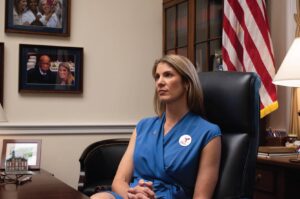
 Congresswoman Lori Trahan (D-MA-03) this week applauded the approval of key provisions of her and Congressman Jay Obernolte’s (R-CA-23) bipartisan AI discussion draft by the House Committee on Science, Space, and Technology.
During Thursday’s markup, the Committee advanced multiple bills that contained priorities in the draft text of the Great American Artificial Intelligence Act (GAAIA) published earlier this month.
“Passage of these bills is a real step forward, and it happened because members of both parties decided the American people can’t afford for Congress to stay on the sidelines of the AI debate. I’m especially proud of the CAISI bill, which will put scientists and security experts at the center of our national response to AI,” said Congresswoman Trahan. “There’s much more to do, including giving CAISI the authority to create the standards we need to know whether a frontier model is safe before it ships, not after something goes wrong. I’ll continue working with members on both sides of the aisle to craft real rules of the road for the companies developing this powerful technology.”

Specifically, the Committee advanced the following provisions of GAAIA with bipartisan support:
H.R. 9363 establishes a Center for AI Security and Innovation (CAISI) under the National Institute of Standards and Technology (NIST) to evaluate frontier AI models for national security risks and support voluntary standards. GAAIA Section 102.

H.R. 6461 directs NIST to build a standardized “model card” documentation template and technical guidelines for AI models. GAAIA Section 123.
H.R. 5584 instructs the National Science Foundation (NSF) to create competitive awards to develop K-12 AI literacy curricula, teacher training, and evaluation tools. GAAIA Section 211.

H.R. 5351 adds NSF student scholarships and fellowships in AI in addition to research on the use of AI tools in education. GAAIA Sections 231, 233.
H.R. 2385 establishes the National AI Research Resource (NAIRR) to federate compute, data, and tools for U.S.-based researchers. GAAIA Section 423.
H.R. 9334 directs NSF to create interdisciplinary “trustworthy AI” fellowships and a NIST AI workforce framework. GAAIA Sections 221, 231.

GAAIA was released as a discussion draft this month to solicit feedback on provisions targeting frontier AI development, national and cybersecurity threats, workforce challenges, and the incorporation of AI into education systems. The lawmakers are continuing to collect input from stakeholders.
Text of the discussion draft can be accessed HERE.
A section-by-section summary can be accessed HERE.

















3 responses to “House Panel Approves Key Trahan AI Priorities”
With all due respect Congresswoman Trahan, while I highly respect your attempt at bipartisanship, I must also highlight the great irony. You majestically sit at your desk in your congressional office in Washington and hanging on your wall is a photo of civil rights giant and icon John Lewis alongside a snapshot of the historic State of the Union where Democratic women dressed in suffragette white championed and fought for equality. Yet, despite surrounding yourself with the photo imagery of these historic and very significant struggles for ALL working people, women, minorities and systemic inequality, your “Great American AI Act of 2026” instead betrays them!
Why, because it will be a Big Win for Big Tech only and at the expense of the poor and marginalized workers. In the bill, its enforcing a “three-year freeze on state laws” which basically “strips local governments of their power to protect citizens from algorithmic hiring bias and workplace surveillance”. Our country’s strongest worker and consumer protections have ALWAYS started at the state level. Forcing a three-year pause on local rules only helps Big Tech corporations and hurts everyday citizens. Even worse, the bill’s $500 million revenue threshold creates a massive corporate loophole, leaving powerful AI developers free from safety audits. Instead of saving American jobs, the bill merely updates the “WARN Act” which basically just forces companies to tell you that AI took your job 60 days after they decide to fire you. The workers need REAL protection from AI by prioritizing HUMAN livelihoods and jobs over Big Tech profits. This bill is very unjust, unfair and one-sided! This bill is a step backward!
Also Congresswoman Trahan, the serious concerns and real-world consequences of your bipartisan bill are playing out right now in your own home district. In Lowell, the Markley Group data center is facing an active city-wide ban and a major environmental lawsuit from the concerned residents fighting corporate pollution and the skyrocketing utility bills.
Your bipartisan bill’s $500 million loophole completely lets massive data centers like Markley off the hook. How? Because by exempting these “mid-tier tech operators from federal safety rules”, you are protecting corporate profits while completely ignoring the facilities that pollute our neighborhoods and drain our power grids.
While ALL of our Lowell City Councilors, most especially Councilor Kim Scott who represents the heavily impacted District 5, as well as Governor Healey, are and have been fighting very hard to protect Massachusetts’s hardworking taxpayers and citizens, your federal bipartisan bill threatens to give “Big Tech” the ultimate legal loophole to steamroll local zoning laws and ignore environmental damage all in the name of “AI progress”. We need YOU to protect your own constituents, not “Big Tech” profits.
As I high school teacher and as a former software engineer (I know teach a foreign language), I have witnessed how technology has made education in K12 more difficult. All too frequently, we as a society, become enamored with the glitteriness of the latest gadget. The rise of AI has made a bad situation much worse. (I would say not just in the classroom, but in the rest of society). Technology is also much more expensive than textbooks. Learning is not an easy task, it is a struggle and that struggle and its concomitant pain is crucial. Deep learning for the human brain is an active process, not a passive. AI and technology make it too easy.
Students have become lazy thinkers, and many refuse to exercise their brain muscle, as it is easier to use AI. The adolescent brain is geared toward getting around rules, do we need to make it easier for them? We should resist most AI in K12 settings. I do not mean to suggest that all technology is bad, but we should seriously consider limiting its use further than just saying no phones in the class. Trying to teach students who are on their Chromebooks or other tech devices is almost as challenging. I apologize for my rant.