

Family and friends turned out in force to support recruits. (Photo Courtesy Lowell Police Department)
LOWELL — Thirty recruits walked onto the stage of the Lowell Memorial Auditorium on Friday, saluted, received a handshake and certification documents, and then walked off the stage as a police officer amid the cheers of family and friends.
Moments later, the new officers were preliminarily sworn in, and their family members pinned their badges onto their uniforms for the first time.
In it’s 30th year of operation, the Lowell Police Academy graduated another class of officers on Friday morning.
The 21-week academy has been in operation since 1996, providing recruits with hundreds of hours of training in constitutional law, criminal law, criminal investigations, First Aid and CPR, firearms and defensive tactics, emergency vehicle operations and more.

The academy is certified by the Municipal Police Training Committee (MPTC), and overseen by Lowell Police instructors and senior officers.
 New officers now leave the academy for Brookline Police, Acton Police, Billerica Police, North Reading Police, Peabody Police, Malden Police, Revere Police, and Somerville Police.
“I congratulate all of these new officers on their hard-earned graduation. The Lowell Police Academy is rigorous and our expectations are high, but I still told these officers at graduation that this will be the easiest part of their careers. Now the real work begins,” said Lowell Police Superintendent Greg Hudon. “I want to thank these new officers for their dedication, and I want to thank their families for being so supportive.”
-

- The Lowell High School Choir sang the National Anthem prior to the graduation. (Photo Courtesy Lowell Police Department)
-

- Recruits from Lowell, Chelmsford, North Reading and Malden were among those who graduated. (Photo Courtesy Lowell Police Department)
-

- Lowell Police Superintendent Greg Hudon welcomes recruits, family and friends to the ceremony (Photo Courtesy Lowell Police Department)
-

- A new Brookline Police Department Officer smiles while watching a highlight video (Photo Courtesy Lowell Police Department)
-

- Lowell Police Officer Baylee Teal salutes Officer Tim Cooper, Sgt. Tom Hickey and Officer Tim Roussell just before receiving her graduation certificates on stage at the Lowell Memorial Auditorium. (Photo Courtesy Lowell Police Department)
-
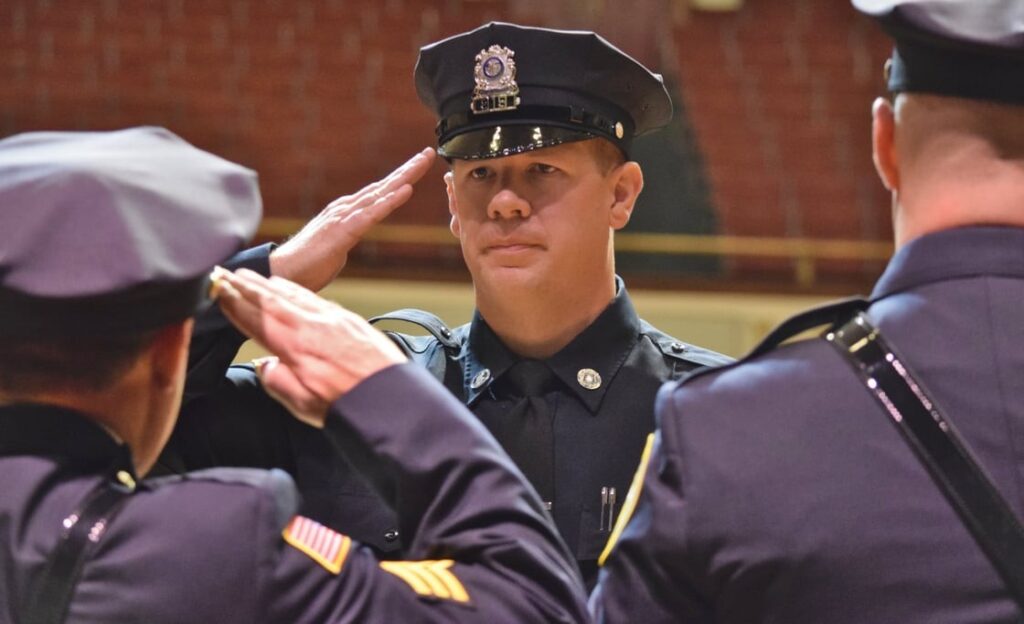
- Officer Greg Jumpp salutes just before receiving his graduation certificates. (Photo Courtesy Lowell Police Department)
-
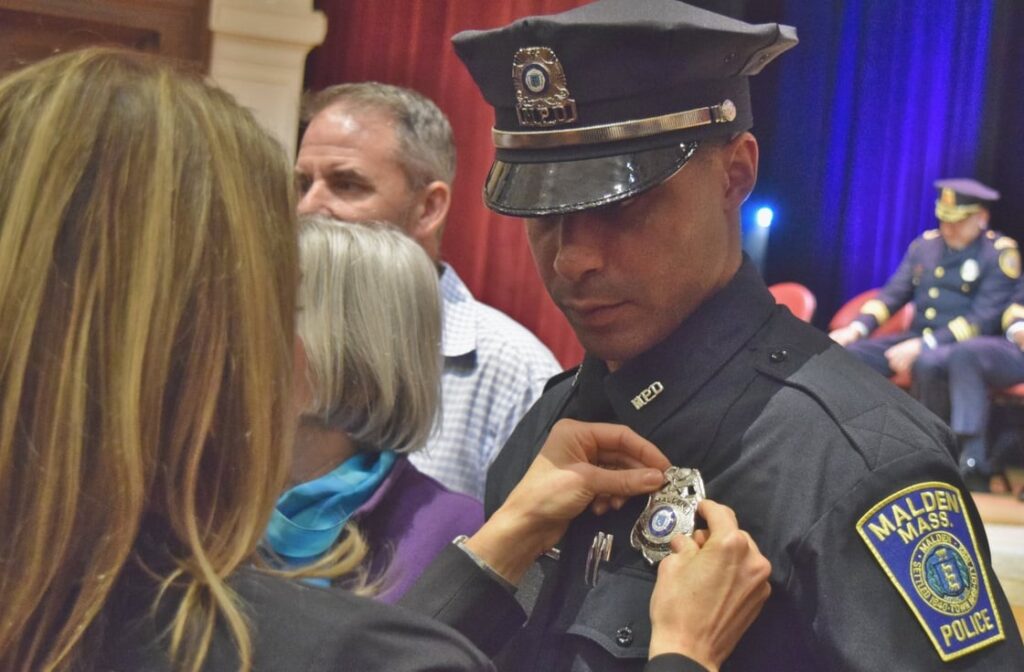
- A Malden Police Officer has his badge pinned to his uniform by a family member. (Photo Courtesy Lowell Police Department)
-

- Command staff, instructors and new officers from the Lowell Police Department stand together on stage at the Lowell Memorial Auditorium after graduation. (Photo Courtesy Lowell Police Department)

















2 responses to “Lowell Police Academy Graduates 30 New Officers in its 30th Year”
GREAT NEWS and CONGRATULATIONS!
NOW this is greatly needed for the Firefighters in Lowell:
Hiring new fire-fighters yes causes an immediate cash shock, but the reality is that maintaining the status quo is what’s truly burning through the budget, to the tune of roughly $1 million every two and a half months in emergency overtime. With overtime projections threatening to exceed $5 million, nearly 20% of the entire salary budget, action is needed now.
By filling the current department vacancies to consistently exceed the court-mandated 203 minimum baseline and aggressively hiring toward the department’s true 213 full complement, the city can build a buffer. This will directly absorb medical leaves and the massive spikes in sick leave which recently hit 527used sick days in a mere 77-day span. All without triggering the expensive mandatory shift call-backs that cause sudden station closures, systematically replacing emergency overtime with regular salaries.
Of course, critics of structural change will point to the immediate roadblocks. The first hurdle is the timeline itself. While hiring new recruits saves millions long-term, it takes roughly six months to get a new hire through the Massachusetts Firefighting Academy and mandatory EMT certifications. During this transition, the city will experience a temporary budget overlap where they are paying both the high overtime rates and the on-boarding costs of new recruits before the actual savings materialize.
But, by structuring this as a staggered hiring plan, the immediate overtime savings realized by the first wave of recruits can directly fund and subsidize the training costs of the next class. It will require strict fiscal discipline from the administration, but it ensures we bridge the cash gap smoothly.
Because over 70% of 911 calls are medical emergencies, the City Administration can formally initiate impact bargaining with Lowell Firefighters Local 853 to change to a tiered response model during peak demand times. Through the collective bargaining process, the city can legally integrate smaller utility vehicles equipped with the same lifesaving gear and EMT-certified personnel, while keeping those million-dollar firetrucks fully staffed and ready in the neighborhoods by using the “peak-demand float pool”. Then by gradually on-boarding new recruits over time, the city can replace expensive overtime hours with regular salaries.
The second hurdle is the union negotiations. Integrating smaller utility vehicles and introducing flexible scheduling requires opening up the collective bargaining agreement. Unions protect minimum staffing per vehicle for safety, and changing vehicle deployment can easily be seen as an operational cut. So, it must be a collaborative partnership ensuring a higher base pay, which will build trust. Firefighters will gain long-term financial stability, while taxpayers get neighborhood fire stations that remain fully staffed. This eliminates wear and tear on firetrucks for non-emergency medical runs.
Furthermore, the city should consult with the Fire Chief and conduct a collaborative, data-driven risk-management assessment of helipad standby policies. This will determine whether routine, non-emergency air ambulance arrivals under the Massachusetts State Fire Code (527 CMR) can be safely managed with lower-cost public safety details.
Councilor Juran is exactly right to target the structural, operational root causes of this crisis. While Mayor Gitschier and Councilor Robinson’s motion to request voluntary funding fees from the tax-exempt community partners is a well-intended effort to secure immediate relief, the legal truth is that the city cannot force non-profits to pay under Massachusetts Law. Relying on voluntary service fees or PILOT agreements is historically an unreliable, band-aid approach for long-term budget balancing. If we want to save millions of dollars and permanently guarantee that every neighborhood fire station stays open, we cannot simply ask for voluntary assistance. We have to look inward and fix the system.
Investing in structural efficiency is not a financial risk, its the only legal and sustainable way to save millions of our hardworking taxpayers’ dollars while keeping every single neighborhood fire station open. This is a true win-win fiscally prudent approach because by staggering new hires, the city can fund their training directly out of the immediate overtime savings, no new money, just converting the $1 million spent every 2.5 months on overtime into predictable, regular salaries through staggered hiring.
Meanwhile, through fair quid-pro-quo collective bargaining, we can offer firefighters higher guaranteed base pay in exchange for flexible scheduling and smaller medical vehicles. It is a collaborative partnership that protects our firefighters, saves millions for the hardworking taxpayers, and keeps every neighborhood fire station open.
The above mentioned structural efficiency strategy is in reaction and response to what’s needed to fulfill the legislative priorities of both former Councilor/Mayor Rourke and Councilor Robinson. By also implementing the requested data-driven, internal administrative audit via human resources, the administration can directly answer former Councilor/Mayor Rourke’s urgent call for fiscal accountability and target the root causes of the unsustainable leave patterns.
Because when the city aggressively hires toward the true 213 full complement, they can also implement Councilor Robinson’s steadfast refusal to compromise public safety or cut critical front-line positions. This is my intent, it’s about combining Rourke’s past demand for strict oversight with Robinson’s vision for a fully staffed fire department.