
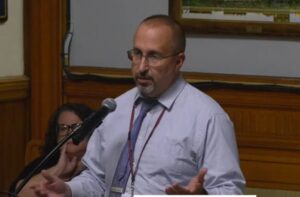
Technology Director Greg Limperis addresses the subcommittee. (Image from Lowell Telemedia broadcast of subcommittee meeting)
by Qinglong Diep
Last Wednesday night, the Lowell School Committee Joint Finance and Curriculum and Instruction Subcommittee met to discuss the multiyear technology lease agreement which would cost the Lowell Public Schools District roughly $3.45 million over the course of a 5 year period.
The meeting came about after the August 19th School Committee meeting, when School Committee member Dave Conway’s motion to send the Apple Inc. and Whalley Computer Associates contracts to a joint subcommittee passed unanimously.

The lease agreement presented to the joint subcommittee was for a five-year deal covering the district’s one-to-one Chromebook program for students. The program would cost $448, 172.50 annually and include a separate, four-year, $1.4 million lease for about 1,750 Apple devices for teachers, according to Assistant Superintendent of Finance Dr. Derek Pinto and Technology Director Greg Limperis.
According to Limperis, the teacher devices would be the MacBook Neo at an average price of about $800 apiece and include AppleCare Plus coverage, which allows up to two free repairs annually.

Limperis told the subcommittees that current teacher laptops, purchased in April 2021, are approaching the seven-year mark at which Apple stops issuing software updates, leaving devices vulnerable to security risks. He said delaying a decision would raise per-device costs by $20 to $30 should a decision on the teacher devices not be made soon, as Apple cannot guarantee to hold the current price quote.

Kara Wilkins, who oversees the Lowell Teacher Academy and has served as a district instructional technology specialist, told the committees that one-to-one access has become embedded in daily instruction, from state testing requirements to special education accommodations. She said a survey of Kindergarten through 2nd grade teachers last year found 80% wanted to keep one-to-one devices, citing tight schedules that make sharing difficult in the event that an assessment needs to be done at the same exact time.
“The idea that a student who’s struggling with reading or writing can open a Chromebook and be able to get all of their thoughts out and actually be able to produce something is central to accessibility efforts,” Wilkins said, adding that devices support translation tools and text-to-speech for students with disabilities.
 Conway raised concerns about both cost and adolescent screen time, saying research increasingly points to negative effects.
“Kids are spending too much time on that screen,” the school committee member said, while acknowledging technology’s role in students’ futures. He also asked administrators to pursue outside funding, suggesting the district explore corporate and foundation grants, as it has in past budget crunches.
Skinner cautioned that grant funding typically supports one-time or innovative initiatives rather than recurring costs like equipment leases.
Committee member Fred Bahou, chair of the Finance Subcommittee, questioned Limperis on why the district was favoring Apple over lower-cost alternatives like Lenovo or Dell Chromebooks.
Limperis responded that a district pilot found Chromebook batteries drained faster than Apple devices, attributing the difference to how Google’s infrastructure continuously communicates with servers.
 “In the research that I’ve done, Apple’s can hold battery for as long as 16 hours,” Bahou said, comparing it with about 12 hours for Lenovo models.
Limperis said a comparable Chromebook Plus currently costs more than the Apple option at around $900, partly due to new AI-capable chips driving up prices.
Limperis also noted Apple devices retain more resale or trade-in value, saying the district expects roughly $200,000 back in credit at the end of the lease term. He did acknowledge, however, that the contract language does not explicitly guarantee that figure.
Bahou directed Limperis to prepare a spreadsheet comparing lease and purchase costs for Apple devices against Chromebook alternatives, along with an inventory of current district devices by type and age.
 Committee member Eileen DelRossi asked that the data include a breakdown by staff role of who has an Apple device or a Chromebook Plus, saying it could help identify surplus devices that might be redirected to younger students.
Bahou said the subcommittees hopes to meet again before October 1, citing a September 15 deadline in the current Apple contract terms. He noted the student device timeline would likely require a separate meeting given the scale of the investment.

















One response to “School Subcommittee Discusses Whether Tech Costs Compute”
I’m wondering if anyone has looked at the data that compares traditional v tech-assisted student learning. Perhaps somebody takes a glance at Jared Horvath’s recently published The Digital Delusion. Horvath cites rigorous, extensive PISA and OECD international studies that suggest the appropriate, limited context of tech apps has grown wildly out of proportion and control. Lowell’s numbers suggest this point.