
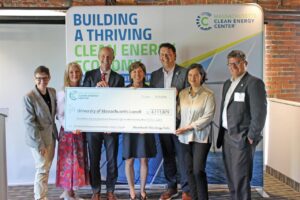
From left, UMass Lowell Vice Chancellor for Research, Innovation and Economic Development Anne Maglia, UMass Lowell Associate Vice Chancellor for Research and Innovation Acceleration Kim Holloway, MassCEC CEO Ben Downing, Executive Office of Energy and Environmental Affairs Secretary Rebecca Tepper, UMass Lowell Associate Vice Chancellor for Sustainability and Enterprise Development Ruairi O’Mahony, Business Strategies Undersecretary Zenobia Moochhala and UMass Lowell Director of Urban and Community Development Craig Thomas. (Photo courtesy of MassCEC)
LOWELL – The Massachusetts Clean Energy Center (MassCEC) awarded UMass Lowell more than $4.1 million to develop a housing innovation testbed, where innovators can reimagine how to retrofit existing homes and design new housing that is sustainable, affordable and scalable.
MassCEC CEO Ben Downing, alongside Executive Office of Energy and Environmental Affairs Secretary Rebecca Tepper and Business Strategies Undersecretary Zenobia Moochhala, announced the award during an event held at UMass Lowell on Tuesday. The grant comes from MassCEC’s Climatetech Testing and Demonstration Assets (TDA) Program, which invests in shared infrastructure that enables climatetech companies to test, validate and demonstrate their technologies in real-world settings.
A total of $18 million was awarded to five Massachusetts-based organizations and institutions, including UMass Lowell. The awards are the first to be issued from climatetech funds established under the Mass Leads Act.

“Breakthrough climatetech ideas depend on access to the right testing environments to reach the next stage,” Tepper said. “This program expands that access and helps turn promising innovations into viable, market-ready solutions that attract further investment and growth here in Massachusetts.”

The housing innovation testbed will include new construction and retrofit demonstration sites, as well as a makerspace known as the Sustainable Materials Innovation and Research Center (SMIRC). The testbed will be part of the UMass Lowell-led BuildSmart Housing Innovation TechHub, which aims to address the state’s lack of affordable housing through innovation in design and sustainability, zoning and policy, and manufacturing and construction. BuildSmart is a designated TechHub through the Massachusetts TechHubs Program, an initiative intended to strengthen regional innovation ecosystems across the state.

“Massachusetts’ housing challenges demand bold, collaborative solutions, and UMass Lowell is proud to help lead that effort through BuildSmart,” said UMass Lowell Chancellor Julie Chen. “Thanks to MassCEC’s investment, the testbed will create a unique environment for accelerating housing innovation that expands access to affordable, energy-efficient housing across the commonwealth.”
 The construction demonstration sites will be developed on university-owned properties for innovators to test new construction techniques. The sites will enable startups to demonstrate material performance, speed of construction, cost savings and embodied-carbon reductions in real housing units. The retrofit demonstration site will serve as a testbed for retrofit innovation, opening opportunities for companies to validate low-carbon structural repairs, overlays, panels and prefabricated retrofit elements that are particularly relevant to aging housing stock common across Gateway Cities like Lowell.
SMIRC will serve as a makerspace for developing, prototyping and scaling sustainable materials and building technologies that promote affordable climatetech innovation in housing and infrastructure. Housed within the Lowell Innovation Network Corridor (LINC), a growing innovation ecosystem driving research and economic growth, SMIRC will consist of four physical spaces:
- Materials Innovation Lab that enables the discovery, development and testing of sustainable materials
- Digital Fabrication Zone, which integrates advanced manufacturing, robotics and additive fabrication to design and produce modular housing components using sustainable materials
- Energy and Climate Tech Bay that will serve as a testing area for renewable energy systems, building-integrated photovoltaics and smart microgrids
- Collaboration and Learning Space, which provides a shared environment where researchers, students and industry partners can co-develop solutions for sustainable housing

“The testbed is designed to bring together researchers, industry partners, entrepreneurs and students in a collaborative environment that supports every stage of sustainable housing innovation, from discovery and prototyping to testing and deployment,” said Kim Holloway, UMass Lowell’s associate vice chancellor for research and innovation acceleration. “By creating this ecosystem and expanding demonstration sites across campus, we can advance scalable solutions that make housing more sustainable and accessible for communities throughout Massachusetts.”
 SMIRC and the demonstration sites will help address Massachusetts’ housing crisis. According to the Healey-Driscoll administration’s “A Home for Everyone: A Comprehensive Housing Plan for Massachusetts,” Massachusetts needs to increase its year-round housing supply by at least 222,000 homes over the next decade to meet demand and lower costs. The MassInc Policy Center estimates that all 26 Gateway Cities in Massachusetts, including Lowell, should add a total of 83,000 new units over the next decade.
“Communities like Lowell are experiencing the impacts of Massachusetts’ housing shortage firsthand, which is why it’s so important to invest in innovative solutions that can be scaled and replicated,” said UMass Lowell Vice Chancellor for Research, Innovation and Economic Development Anne Maglia. “BuildSmart and this new testbed will help create new opportunities for sustainable and attainable housing while strengthening economic growth in Gateway Cities.”

















One response to “UMass Lowell Awarded $4.1M Grant to Develop Climate-Resilient Housing Innovation Testbed”
This is GREAT news because it means the IMMEDIATE creation of construction and manufacturing jobs for Lowell residents!