
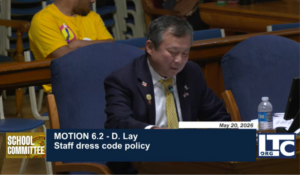
Image from Lowell Telemedia broadcast of May 20, 2026 Lowell School Committee meeting.
by Qinglong Diep
LOWELL – The Lowell School Committee voted 4-3 Wednesday’s night to reject a motion requesting the Superintendent review the staff dress code policy.
The motion, brought forward by School Committee member Dominik Lay, originally called on Superintendent Liam Skinner to review the dress code policy and consider prohibiting teachers from wearing t-shirts and shorts during school hours.
Prior to the vote, the motion was amended to remove the prohibition language after Committee member Fred Bahou said he could not support it as written, but would back a version limited to a policy review. Committee member Dave Conway, who had seconded the original motion, indicated he shared Bahou’s view.

Lay agreed to the change and the committee stripped the clause prohibiting t-shirts and shorts, leaving only the request for a superintendent review. The revised version still failed, however.
Lay, Bahou and Conway voted in favor of the amended motion. Mayor Erik Gitschier, along with Committee members Connie Martin, Danielle McFadden and Eileen DelRossi voted against the amended motion which was made by Conway.
 The meeting’s sharpest exchange, however, came during public comment on the matter.
Bridget McNulty Davila, a Lowell Public Schools teacher, connected the dress code proposal to broader workplace conditions. She opened her remarks by telling the committee her classroom reached 36-degrees on December 15th and 89-degrees the day before the meeting, the same day her students were taking MCAS.
“Teachers are demoralized,” she said, pivoting to budget cuts, student services and school building conditions. “The choice to put forward a motion to police our clothing at this moment, when we are facing budget cuts and when our buildings are already unbearably hot and cold, is degrading, nonsensical and completely disconnected from the actual issues facing our students.”
 Mayor Gitschier interrupted mid-comment, asking her to “stick to shirts and shorts” and not make broad statements.
McNulty Davila pushed back, saying teacher morale was directly relevant to the motion.
When Gitschier suggested he understood the morale issue, she replied flatly, “I don’t think you do, sir.”
Gitschier pushed back, asking the speaker to “stick to the topic at hand,” which lead to a few seconds of awkward silence where the teacher crossed her arms and stared at the Mayor.
 “You certainly could do that for a minute and four seconds,” said Gitschier, an apparent reference to the time she had remaining in which to address the committee.
“I would love to,” McNulty Davila responded with a sneer in the Mayor’s direction. “I teach seventh grade. I can wait all day.”
She was ultimately allowed to finish her remarks with roughly a minute remaining on her speaking time.
Lay said the motion stemmed from a complaint from someone he has been told about involving a teacher or two wearing what was described as an undershirt or a crumpled t-shirt pulled from forgotten laundry.
 He said he did not anticipate the motion would generate such a reaction, and acknowledged the issue likely affected very few staff members out of the thousands employed in the district. He framed the motion not as a broad policy overhaul, but as a question of whether any dress code existed at all and where its limits were.
Martin argued the matter belonged at the building level, not the committee level.
“I really feel like this is a building-based decision,” she said, adding that when problems arise, the conversation should be between a Principal and their staff.
McFadden noted that many teachers wear school-branded t-shirts for fundraisers, spirit days and MCAS encouragement events, apparel she said students genuinely connect with.
 “We have much bigger fish to fry and we don’t want to penalize the people that are frying the fish,” she said.
Conway, who seconded the original motion, said he had spent more than 40-years in education and had seen dress-related issues firsthand. He backed the amended version, saying a superintendent review was reasonable and consistent with how schools evaluate policies at the end of each year.
Gitschier said he had personally visited eight Lowell schools over the past four months and had seen nothing out of the ordinary. He noted that existing contracts and Principal authority already govern the issue, and suggested the Superintendent’s time would be better spent elsewhere.
The Mayor added that a teacher’s more casual dress can sometimes help students feel comfortable and engaged. He said that he would not support either version of the motions.


















2 responses to “School Committee Rejects Staff Dress Code”
Teachers now a days would have never gotten a teacher position if they showed up like they do now. Different colored hair and piercings. But besides that I personally have watched a para/ teacher show up at Stokolsa School with leggings and a small T-shirt that exposed her mid drift. The girls at that school wear sport bras and shorts with their buttocks sticking out. My daughter had to have shorts from the knee down and no tank tops because it was distracting to boys. It’s sad how the schools have really gone down over the years. These young girls should be shown to have respect for themselves. I personally think it’s disgusting that some of these teachers are supposed to be role models! Just my personal opinion!
I grew up on Lowell and went to Lowell Public Schools. Graduated high school in 85.
I was told once I couldn’t wear the shirt I was wearing. It was showing my midriff. At the time I didn’t even know what a midriff was. It only showed my midriff if I moved a certain way. Another words it didn’t show my midriff constantly. It wasn’t as short as some of the midriff show apparel we see now.
It did touch the high waisted pants I was wearing. In my opinion the dress code of the students should be enforced. I think the principle of the school she attempt to address an issue with teachers dress code. If a resolution can not be meet then principle can use his resources to find a resolution.