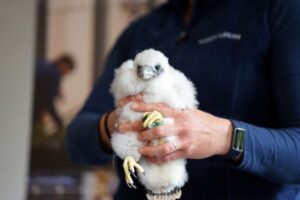
A Peregrine falcon chick hatched at UMass Lowell in May. (Photo courtesy Edward Brennen for UMass Lowell)
LOWELL – Five peregrine falcon chicks have officially joined the UMass Lowell flock now that state wildlife biologists have tagged the birds with identification bands that enroll them in state and regional monitoring and protection programs.
The clutch of chicks – two females and three males – hatched in May to a pair of adult falcons living in a nest box on the roof of the university’s Fox Hall, the tallest building in Lowell. On Monday, biologists from the state Division of Fisheries and Wildlife and the Department of Transportation’s Wildlife and Endangered Species Unit visited the chicks to assess their health, identify their gender and share information about their diet and habitat.

Led by Chalis Bird, the DFW’s northeast district wildlife biologist, the team retrieved the chicks from the nest box while guests watched on video monitors from inside the building. Once in hand, the chicks were brought inside where they were fitted with numbered metal leg bands that will allow conservationists to track the falcons over their lifespan, typically about 10 years. The chicks were safely returned to the nest box about an hour later. They will fly to new territory as young birds this August.
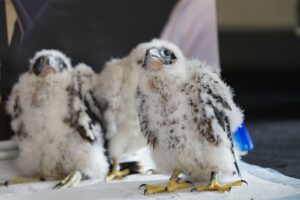
Three of five peregrine falcon chicks hatched last month in a nest box atop UMass Lowell’s Fox Hall. (Photo courtesy Edward Brennen for UMass Lowell)
“This is an amazing program,” Bird said, thanking the UMass Lowell volunteers who monitor the nest box year-round. “We want to make sure we are tracking, we want to make sure there are no natural causes of (the falcons’) decline.”
Peregrine falcons are the fastest birds in the world, reaching dive speeds of more than 240 mph in flight. They are highly adaptive and live in a variety of urban and rural environments. But, due to the prevalence of the pesticide DDT by the mid-1960s, there were no falcons nesting in the eastern United States, and the birds were federally designated as an endangered species. After DDT was banned in 1972, efforts to rebuild the population began.
 This year marks the 40th anniversary of the state’s peregrine banding and restoration efforts. Today, the falcons’ status in Massachusetts has been upgraded to birds “of special concern.”
Attending Monday’s banding session were staff members from UMass Lowell’s Rist Institute for Sustainability and Energy, which oversees the university’s falcon initiative; program volunteers; UMass Lowell students; and Nicolai Konow, a UMass Lowell associate professor of biological sciences who advises the university’s chapter of the Wildlife Society.
The group formed after Bird visited Konow’s classroom and encouraged students to establish the chapter. This spring, 35 students joined up to become what Bird called “the next generation of conservationists.”
Erika Morse, a UMass Lowell biology major from Newburyport, is the chapter’s first president. She attended the banding event on Monday.
 “I love biology. I grew up working with animals and I am passionate about it,” she said.
UMass Lowell’s care of the raptors is just one of the initiatives that exemplifies the university’s commitment to sustainability and the environment. The university is the highest-rated campus for sustainability in Massachusetts, according to the Association for the Advancement of Sustainability in Higher Education (AASHE). The organization has designated UMass Lowell as one of 11 platinum-rated campuses in the U.S. and one of 18 in the world.
A mating pair of the majestic peregrines has called Fox Hall home since at least 2007, when the birds were discovered on the building’s gravel roof – falcons do not build conventional nests but often lay their eggs out in the open. The university then constructed the nest box to shelter the birds from the elements and better ensure their success.
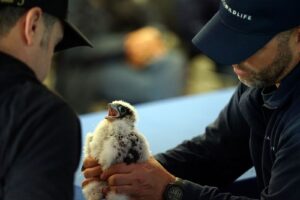
David Paulson, supervisor of the state Department of Transportation’s Wildlife and Endangered Species Unit, left, and Division of Fisheries and Wildlife technician Ryan Meuse, right, assess a peregrine falcon chick at UMass Lowell on Monday, June 1. (Photo courtesy Edward Brennen for UMass Lowell)
Also known as “duck hawks,” the falcons are UMass Lowell’s real-life River Hawks – the namesake of the university’s athletic teams. Over the past 19 years, more than 50 peregrine chicks have been raised atop of Fox Hall. The birds are monitored via webcams that allow the public to see them in their urban habitat high above the Merrimack River. Area schoolteachers often use the birds’ story to help educate children about wildlife.
In 2025, wildlife biologists identified 40 nesting pairs of falcons across the Bay State. Falcons raised at UMass Lowell have gone on to establish other nests in Massachusetts, New Hampshire, New Jersey and Rhode Island.