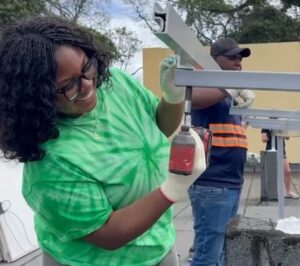
Political science major Nadia Eshun uses a drill to install a solar panel mount. (UMass Lowell photo)
When entering a dark room, most people turn on a light without thinking twice, but for 730 million people worldwide, access to electricity is scarce.
“People deserve to have these basic necessities. It shouldn’t be something they have to fight for,” said Jacob Hoffman, a rising junior mechanical engineering major at UMass Lowell.
Hoffman and seven other UMass Lowell students completed a mechanical engineering directed study during the spring semester, which included a one-week trip to Sosúa, Dominican Republic, where they installed solar panels for residents without reliable electricity. The trip was sponsored by UMass Lowell’s Center for Energy Innovation (CEI) and the Energy Access Foundation, whose mission is to accelerate access to sustainable energy in developing countries.

“We were able to help people in need and, at the same time, help educate students and give them a valuable experiential learning experience,” said Christopher Niezrecki, CEI’s director and a professor in the Department of Mechanical and Industrial Engineering, who led the directed study. “The students got a better understanding of what life is like without the resources that we take for granted.”

Working alongside representatives of the Energy Access Foundation, the students installed solar panels at a school in the Bella Vista neighborhood of Sosúa. They then presented to the school about solar power and how it will help their educational experience.
“We were all very touched by how much this means for the community and how this will help them keep the school up and running when they have power outages,” said Nuala Rodgers, a rising junior climate change and sustainability major.

The students also installed solar power systems at three homes in the area. They designed the systems before the trip, after researching quality, cost-effective solar components and studying how much sun Sosúa receives.
“It’s really nice that the projects we engineered and installed are making an impact on people’s lives by bringing them light and energy,” said Ryan Aitsaid, a rising junior electrical engineering major.
 The students learned a valuable lesson during the trip: Not everything goes as planned. They faced multiple challenges, including tin roofs being too sharp to wrap wires around and screw holes from mounting brackets posing leak hazards. However, they got creative and found solutions for each issue that appeared.
“Designing a system in the classroom, everything is working under ideal conditions, but when we actually got down there, we had to have backup plans to adapt our system,” said Jackson DeMello, a rising junior electrical engineering major. “You need to have that hands-on experience to actually understand how something will work.”
While in the Dominican Republic, the students immersed themselves in the culture. They tried local cuisine, participated in activities like surfing and explored the nearby city of Puerto Plata.
“I felt connected to the people,” said Nadia Eshun, a rising junior political science major. “They really made me feel at home.”
 The students are getting updates from the Energy Access Foundation on how their solar power systems are performing.
“An important part of installing these projects, both at a larger scale at the school and smaller ones at the homes, is that our mission wasn’t just to install and forget about it. It’s about sustained community impact,” Rodgers said. “In the case of the school, we heard that they had an all-day power outage recently, but with the power generated from our solar panels, they were able to keep school in session all day.”