
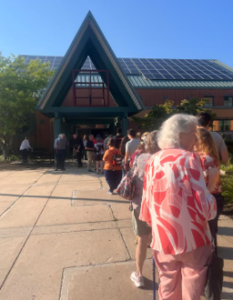
 On Monday, June 29th at 6 pm, the Lowell Department of Planning & Development (DPD) held a data center public forum to discuss zoning at the request of the City Council. The description stated:“This forum will provide an opportunity to learn more, ask questions, and share feedback. All residents are welcome.”
It began around 6 pm with Camilo Espita from DPD explaining how data centers help support a lot of things including universities, hospitals, Instagram, and TikTok. It ended around 7 pm with a 14-year-old being escorted out by police while she yelled “we don’t want data centers.”
Lots of people showed up
On a hot Monday night during a holiday week, for a meeting about zoning of all things, there was an actual line to get into the building at 5:55 pm.
The Markley data center specifically had gotten some recent attention on both local and national news (it is located in Lowell and is the largest current data center in MA, at 40-50 megawatts). This level of public engagement on a local issue was “special” for lack of a better word.
I wondered if there was a group from out of town that had brought in a crowd or something. I asked the girl in line next to me what brought her here and where she lived. She said she lived in Dracut but heard about this and wanted to show her support for the neighbors. She was in scrubs and looked like she’d come right from work.

To say the city probably underestimated the amount of people that would show up that night is an understatement.
Jovani Baez-Rose and Camilo Espita gave a well-prepped presentation (slides here) and recognized the elected officials who were in the room (Councilors Kim Scott, Sean McDonough, Sokhary Chau, Belinda Juran, Rita Mercier, and Mayor Erik Gitschier). Also in the room were some people running for office (Lorena Betts, Harini Ayer, Joe Espinola, John Drinkwater) [apologies if I forgot to mention anybody].

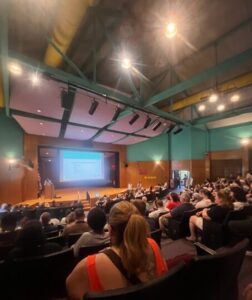
Information from city staff who counted seats at the end was that the auditorium holds about 320 people. My estimate is that there were at least 200 people there and there were also people standing up in the back.
The 45-minute public input session & crowd behavior
After the ~15-minute presentation from DPD, a microphone was passed around by city staff to those in the audience with raised hands. Obviously because of time constraints, there was no way they were going to get to hear everyone, and that was communicated to manage expectations. It ended up being less of a back-and-forth discussion with the city departments and more so people voicing their concerns.
 Here are some notes of what some of those people had to say, but Stephen Malagodi of 350MA of Lowell also took video of the event, which can be found on YouTube here: Lowell Data Center Forum.
First, there were two speakers who cited general problems with AI and their involvement in global wars. Members from the PSL – Party for Socialism and Liberation were present and handing out flyers for their next event. These concerns about global issues were met with some applause from the crowd, but didn’t leave room for the city to give a meaningful reply in the context of municipal zoning. I’m sure their event would be a much more appropriate forum for that discussion.
Next a Markley employee, Christine Durante who confirmed for the crowd that she lives in Lowell, got up to speak and shared that a good number of their customers are universities, like Harvard, and that there were also many finance and education customers.
 She was almost immediately met with loud booing from others in the crowd, which I could hear clearly, since I was seated a bit behind her. She mentioned she was nervous and shaky, but asserted that she had let others talk and was looking for the same level of respect. This was totally fair since it was, after all, a forum for public input.
There was back and forth yelling between other Markley staff seated nearby and members of the crowd. Expletives were tossed around and it felt a bit like a Jerry Springer show. One woman sitting among the Markley staff yelled at the people booing “get a job” and “move out then.”
Christine continued: Jeff Markley has invested $200m in the city when it was struggling. There should be more research and data presented to get to the facts of what the longer-term impacts are.
 Both sides were, in my opinion, disrespecting each other, the organizers of the event, and everyone at the event who wanted to listen and contribute to a meaningful discussion. To be clear, the booing started against this woman by others, and escalated from there.
I noticed there were police by the doorway (which made total sense even before the kerfuffle started, there were a lot of people here).
After it calmed down, Gloria, a recent LHS grad, advocated for the younger generation. “We are a community and they are exploiting us . This is our lives.”
Claude: What if we zone data centers out, what happens to Markley, and if it remains, what do we do to reduce the manage it does?
Answer from Camilo: they are grandfathered in and cannot be zoned out.
 Jon Grossman & Neil Dale, 350MA of Greater Lowell: It is essential that existing data centers negotiate a Community Benefits Agreement with community members being part of the discussion. What do we do about climate? They use tremendous amounts of energy.
Judy Cahill: I don’t want to trade my health for a data centers. They give Markley cuts in taxes. Andover and Haverhill can’t have gas stoves but you want to put a gas generator there?
Justin: what are the current environmental impacts of Markley in Lowell, does the city measure that? Transparency is important. Will the city think about putting this on as a ballot question and have us vote on it and if so, will they abide by the voters wishes?
 Andrew Griffin, a UML alumnus who lives on Beacon St and has a nuclear background: Data centers sound like a utility and should be treated that way. Seabrook’s wastewater can only be one degree higher than what they take in. They are required to be regulated and inspected on a regular basis. Make them adhere to the same policies that are meant to keep us safe.
Mary Wambui offered the last comment before the meeting was set to end: there has been a fight for ten years and it has intensified for the past two years. Jake [Fortes], Honest Future for Lowell and the other neighbors have been sitting here quietly and that should be recognized (they were seated close to some of the PSL members but were very clearly not involved in any of the back-and-forth heckling). How do we know what the city will [document] here as public comment? As a Lowell resident, I want to know what everyone said here tonight. We don’t want our comments to disappear somewhere. Zoning may most likely be applying to a new data center, but I want the existing data center to be affected by new zoning. It is important to have a substantial extension clause in our new code with clear triggers that pertain to the existing data center (increase in fuel storage, energy consumption etc). We want restorative justice. She was met with loud applause from the audience.
 At that time, around 7 pm, the moderators communicated that the public input period was over, even though there were still some raised hands in the audience.
Police removal of the 14-year old student
Towards the back side of the room closest to the entrance wall, a young girl got into the aisle and started speaking in a raised voice, stating that she was 14 years old and had just graduated 8th grade from the Stocklosa School. She told people that they were free to leave and didn’t need to listen to her, but she wanted to say something.
A police officer gestured for her to move towards the exit (you can see this all towards the end of the 350MA of Greater Lowell video towards the end). Mayor Erik Gitschier and Assistant City Manager Shawn Machado were standing nearby, appearing to attempt to de-escalate the situation as it became louder and more tense.
 She raised her hands in the air (in a manner to demonstrate she was not a threat) and exclaimed that she wasn’t hurting anybody as she was escorted out of the room by police.
The audience became louder, some saying “let her speak” and yelling at the police officers. Two arguments then broke out on the other side of the room close to where I was sitting, with one man calling the Markley group sellouts and expletives being thrown on both sides. It felt like a sporting event with angry fans yelling at each other. At a meeting about zoning and data centers.
The 14-year-old was held after the meeting and questioned (more on that here Lowell Police remove 14-year-old from data center public forum). The questioning, in my opinion, was completely unnecessary. She should have just been told to go home peacefully. Hopefully we get to hear more of what she was trying to say in the future. That must’ve been pretty scary for her.
 Meeting Close & Follow-up
After things settled down, Jovani Baez-Rose said that DPD will do a summary and people began filing out of the room, after leaving behind some feedback left on sticky notes on poster boards.
Any feedback should be sent to dpdprojects@lowellma.gov. Hopefully all feedback will be made publicly available at some point.
It was definitely a challenging meeting to run and manage, but it is great to see a genuine effort by the city to engage with the community.
Aftermath on social media
Unfortunately, the meeting obviously didn’t end well. There was fallout on social media, almost immediately by former Lowell City Council candidate Justin Ford, who posted a video of the girl being removed from the forum and made some accusations towards Mayor Gitschier specifically. 16th Middlesex State Representative candidate Lorena Betts also issued a public statement on Facebook.

From Markley
IBEW, in collaboration with Markley, posted a video on YouTube the day after the meeting entitled “The Lowell Story l The Truth about Data Centers” that has since been taken down.
 In it, Jeff Flanagan, Executive VP of Markley, states that “Lowell needs a data center” and that “We are more of a community-service type of data center.” He also points out that the area had been filled with needles and drug dealing before Markley got there. It pans to a clean building with green lawns, with Mr. Flanagan saying that they had planted thousands of trees on the property. It pans to present-day downtown Lowell. Lou Antonellis of IBEW commented on the jobs created by Markley. One staff person in the video said she was a resident of Lowell and stated that there were 50 people working there.
Markley has also since created a website called Keeping Lowell in the Loop | Your reliable neighbor for over 10 years. It directs visitors to sign a petition to have Lowell City Council lift the moratorium. There is a section where it attempts to myth-bust and combat misinformation about the data center. It doesn’t appear to offer any method of directly contacting them to report or document concerns with the data center, or seek general feedback to engage with the community. Your two options are to sign the petition or contact Lowell City Council.
 Where do we go from here?
The amount of people who showed up wanting to learn more, ask questions, and provide testimony but didn’t get the chance to, is an indicator that if the City truly values community feedback, they need to hold another, longer session. After seeing so many people, I was expecting that the meeting would have been extended at at least until 8pm to allow for more speakers since, so many had taken the time to get there.
Perhaps there can be a bigger forum, like the Lowell Memorial Auditorium, where attendees can register beforehand and some ground rules can be set up to avoid what happened on Monday. Maybe set up some working groups.
 Example: Providence City Council recently held a special committee meeting that went on for five hours with the largest agenda item being to hear from the public on rent control and gave opportunity for documented public comment. Here is a recording of that: Providence City Council Meeting |Special Committee on H.O.P.E.| February 18th, 2026.
I am not suggesting that we have a five-hour meeting, but it is clear that a can of worms has been opened. It is a nice coincidence that zoning is being re-examined by the city at this time, and that will have lasting effects that shape the community. This level of public engagement shows that people really care about this issue, and maybe Markley can use it as an opportunity to be more open to hearing concerns and working to be a better partner to the city and to the neighborhood.
 Benefits of a Data Center in Lowell
There are strong arguments for having a data center in Lowell, but it is also hard to make everyone happy. With this much attention on it now, public forums could go much differently if more of the upsides were clearly presented.
For example: hearing directly from the businesses and entities that benefit from having one here, and that Markley helped bring to Lowell in the first place. Maybe at the next forum places like the hospitals, UMass Lowell with the LINC project, Draper Labs, and others can share more about the good sides of having them here and the important role they play in their operations. Congresswoman Lori Trahan could share her perspective from the federal level as well (does the city get more funding by hosting a data center?).
Benefits – with guardrails
Protections and guardrails like the some of those offered by Honest Future for Lowell can be put in place to ensure a better relationship between the community and Markley. This group of neighbors and advocates probably has had the most direct experience with both the effects Markley has had environmentally (noise, air), and experience with communicating any concerns to Markley over the years.

For those reasons, below is a list of some of their non-negotiables and reasoning:
- 𝘕𝘰 𝘮𝘰𝘳𝘦 𝘗𝘰𝘭𝘭𝘶𝘵𝘪𝘰𝘯: No more fossil fuel backup generation. We demand clean air and a move away from industrial reliance on toxic fuels.
• 𝘍𝘪𝘯𝘢𝘯𝘤𝘪𝘢𝘭 𝘗𝘳𝘰𝘵𝘦𝘤𝘵𝘪𝘰𝘯 (𝘋𝘦𝘤𝘰𝘮𝘮𝘪𝘴𝘴𝘪𝘰𝘯𝘪𝘯𝘨 𝘉𝘰𝘯𝘥𝘴): We will not be left with stranded, abandoned industrial sites. Developers must post a bond to cover the full cost of site cleanup and decommissioning.
• 𝘌𝘯𝘥 “𝘚𝘪𝘭𝘦𝘯𝘵” 𝘌𝘹𝘱𝘢𝘯𝘴𝘪𝘰𝘯𝘴: Our proposed “Substantial Extension” clause ensures that any increase in fuel storage or power load triggers a public hearing and a Special Permit. No more bypassing the people who live here.
• 𝘐𝘯𝘧𝘳𝘢𝘴𝘵𝘳𝘶𝘤𝘵𝘶𝘳𝘦 𝘈𝘤𝘤𝘰𝘶𝘯𝘵𝘢𝘣𝘪𝘭𝘪𝘵𝘺: Taxpayers should not subsidize this industry. Developers must fund their own impact studies and infrastructure upgrades.
• 𝗕𝗶𝗻𝗱𝗶𝗻𝗴 𝗖𝗼𝗺𝗺𝘂𝗻𝗶𝘁𝘆 𝗕𝗲𝗻𝗲𝗳𝗶𝘁 𝗔𝗴𝗿𝗲𝗲𝗺𝗲𝗻𝘁𝘀: These must be enforceable contracts that provide tangible, restorative justice to our neighbors.
• 𝘛𝘩𝘦𝘳𝘮𝘢𝘭 𝘌𝘯𝘦𝘳𝘨𝘺 𝘕𝘦𝘵𝘸𝘰𝘳𝘬𝘴: Waste heat is a commodity, not a byproduct. Future zoning must require developers to integrate their waste heat into municipal Thermal Energy Networks.

















15 responses to “Data Center Public Forum: A Recap”
VERY informative. Thank YOU, Mikaela Hondros-McCarthy!
This is a very interesting article. I was also at the forum and I can confirm most of the description of that event.
This article has a piece of that I’ve been looking for! The proposed electrical usage of 40-50MW. What is the source of that data please? Very very important to me and I’m trying to confirm proposed power and water.
Thank you for your help!
Excellent, balanced recap of the forum.
The south Lowell neighborhood members deserve a lot of credit for making city residence aware of what’s going on.
I thought it was odd that the Markley speaker said that more studies and research should be conducted before we ban our place restrictions on data centers. I think I look at that a little differently: let’s hold off on expanding this particular data center until that research is done by independent agencies
Also, from some of what I have read, Markley has not shown much interest in green solutions that would mitigate neighborhood concerns. City zoning should in the future should require Markley to embrace alternative energy sources and green technologies.
Finally, even though data centers have potential negative effects on the entire area, the concerns of the abutters and the immediate neighborhood should be addressed. Markley has apparently been indifferent for too long.
People against data centers are incredibly mislead by socialist crowd. Data Centers are both needed and necessary. I was there, and in my opinion, the 14 yr old was a plant to cause a disturbance. I give Mayor Gitschier all the credit for attempting to keep the meeting orderly and safe. All the problems during the meeting were started by the opponents of Markley, no one can argue this point. Some fool even mentioned ‘slavery’ as part of her remarks. Lowell needs to adapt to the future, or be left behind.
At the end of the day, what’s causing this sudden backlash to data centers is not the need for server space, but the need for computing power to power the Ai startups that are now fueling and effectively taking up most startup capital, making up the most growth in the stock market.
This sudden demand comes at environmental costs, and one must weigh the health of the environment/people and the needs of the market.
And which, btw, Lorraine please refrain from conspiracy in place of genuine concern for one neighborhood. Please.
I walk by the that site every day, and aside from normal construction noise, I haven’t experienced many of the issues some neighbors have described. It’s honestly nice to see some of the landscaping they have put in. I’ve also watched the council meetings and attended a few in person. One point that stood out is that they have said they’re willing to fund an independent environmental study chosen by the city, which seems like a reasonable step to evaluate some of the facts. I haven’t seen any follow up from that.
From what has been presented publicly, this is being proposed as a colocation facility, not an AI hyperscale data center. Those are different types of facilities, and it’s important that the discussion reflects that distinction.
The bigger debate about replacing fossil-fuel backup systems with entirely “green” alternatives is more complicated than it appears. Today’s battery storage systems provide limited duration backup, and large scale battery or renewable backup solutions remain significantly more expensive than conventional generator systems for many critical infrastructure applications. Manufacturing those technologies also has environmental impacts that should be part of an honest discussion. The size of facility to support the battery solution would be triple the size of the current lot.
I don’t think every resident of Lowell will be driving an electric vehicle by 2030 and they claim they want to be and I don’t believe the technology or infrastructure is there yet to fully replace backup power for these facilities. That doesn’t mean we shouldn’t keep improving it. It will take more time.
I believe a reasonable agreement can be reached, but some of the demands being proposed seem difficult to achieve with today’s technology. The conversation will be more productive if it’s based on evidence and engineering rather than assumptions and narratives.
Why did the moderator allow the crowd to boo the Markley employee? Why was the meeting not called to order? Thank you for this recap as I was unable to attend and have been watching what I can of what transpired.
I hope everyone knows natural gas powers our electric grid. If data centers use all our energy imagine what making everyone go to a single source would do to our grid. Can’t have it both ways.
What’s sadly missing from all this is anybody asking the question of where the girl’s parents had gotten to in the fracas. Was she on her own recognizance? Did they put her up to it? Did they have no idea what she was up to that evening? Did her teachers put her up to it? Is she without parents? Context entirely absent.
I am sure that people complained about harnessing the river for water power. They probably didn’t like the fact that they had to put poles and wires in front of their houses either. IMO data centers are needed and should be state regulated (regardless of what your congressperson thinks). My biggest issue is why there? Who thought that plunking this down in the middle of a neighborhood was a good idea? Those old timers there know what kind of neighbor Prince Macaroni was. Joe Pellegrino improved that neighborhood every day. His employees lived there and a happy employee is a good employee. That company gave much more than it took from this city. Drive around that area and see the sidewalk trees around Sacred Heart and Saint Anthony’s. All from Prince. I grew up there and never heard one complaint about trains, trucks, noises or odors from that plant. This thing? Just a dumb spot to put it.
Yesterday, I texted this to Teddy Panos’s INSIDE LOWELL “DAILY PULSE LIVE” show:
“So, to be totally fair to ALL parties involved, it seems to me the most fair and balanced solution could be merging Governor Healey’s strict state wide framework with the Honest Future for Lowell’s proposal, just a thought. This is gonna take a total team effort and compromise because that’s the only way everyone wins. Also, let Congresswoman Trahan and her colleagues make one set of safety rules for the digital software so tech companies don’t have to follow 50 different state laws, and allow Massachusetts and Lowell to keep total control over the physical land, the local power grid, and neighborhood noise limits and environmental concerns”.
Basically and simply, I believe it’s a “Wisdom of Solomon” solution. Why, because you are splitting the “cloud from the ground”. EVERYONE WINS!
Also, I had previously posted and thought that moving the Markley data center to Dracut was the perfect answer to Lowell’s gridlock, but I was wrong! While Dracut has a lot of open land and a massive three natural gas pipeline convergence, it just isn’t economically or legally feasible for Markley. Data centers plug into massive electrical grids and fiber-optic cables, not gas pipelines, and building that heavy electric infrastructure from scratch in Dracut would cost a fortune. Plus, under Governor Healey’s strict new rules, data centers cannot use fossil fuels or regional rivers for heavy cooling. Trying to move to Dracut is a dead end! The “Wisdom of Solomon” solution is the path forward.
Yesterday, I texted this to Teddy Panos’s INSIDE LOWELL “DAILY PULSE LIVE” show:
“So, to be totally fair to ALL parties involved, it seems to me the most fair and balanced solution could be merging Governor Healey’s strict state wide framework with the Honest Future for Lowell’s proposal, just a thought. This is gonna take a total team effort and compromise because that’s the only way everyone wins. Also, let Congresswoman Trahan and her colleagues make one set of safety rules for the digital software so tech companies don’t have to follow 50 different state laws, and allow Massachusetts and Lowell to keep total control over the physical land, the local power grid, and neighborhood noise limits and environmental concerns”.
Basically and simply, I believe it’s a “Wisdom of Solomon” solution. Why, because you are splitting the “cloud from the ground”. EVERYONE WINS!
Thank you for this fair and balance report on the meeting.
So simply put, to make this happen, all Congresswoman Lori Trahan needs to do is completely wipe out, rewrite, and replace the broad and sweeping preemption and current language in Section 3 (the Preemption Section) of the bipartisan bill before it is formally introduced. By replacing that language with a simple, “explicit savings clause”, Congress would be clearly stating that federal technology rules can never override local labor laws or a state, city or town’s total control over its own physical land and power grid.