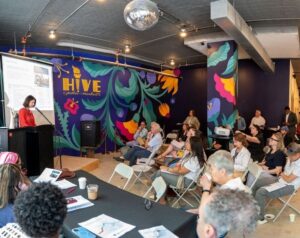
Plan consultant Laurie Zapalac speaks to the crowd at the plan’s release at Hive Public Market on June 5, 2026. (Courtesy Harkins Photography
LOWELL — Mosaic Lowell and the Greater Lowell Community Foundation (GLCF) have publicly released Creativity as Economic Infrastructure: Understanding Lowell’s Creative Economy, a landmark new report examining the scale, diversity, and economic impact of Lowell’s arts, culture, and creative industries.
The report finds that Lowell’s creative economy supported nearly 4,000 direct jobs and generated approximately $364 million in direct annual revenue in 2023. Altogether, the sector includes more than 1,100 creative establishments across Lowell — ranging from independent artists and cultural nonprofits to culinary businesses, manufacturers, designers, media companies, salons, galleries, festivals, and public institutions.

The report was officially launched during a public event held at HIVE Public Market on June 5, bringing together artists, cultural organizations, business leaders, elected officials, educators, and community stakeholders from across the region.

Developed in collaboration with Zapalac Consultants over six months through research, data collection, and local stakeholder engagement, the report provides the first comprehensive benchmark of Lowell’s creative economy and positions arts and culture as a core component of the city’s economic infrastructure and future growth.
“Arts and culture have always been central to Lowell’s identity, but this report demonstrates just how deeply creativity is woven into the city’s economy, neighborhoods, and daily life,” said Jessica O’Hearn, Director of Mosaic Lowell. “This sector shapes quality of life, supports jobs and small businesses, drives tourism, activates public spaces, and helps make Lowell a place where people want to live, work, and visit.”
 The report highlights the breadth of Lowell’s creative sector, including industries not always recognized as part of the creative economy, such as culinary arts, hair and body arts, fabrication, and design. It also examines the role creative industries play in neighborhood revitalization, entrepreneurship, workforce development, and adaptive reuse across the city.
“This report gives us an important tool for understanding the full scope and impact of Lowell’s creative economy,” said Jay Linnehan, President & CEO of the Greater Lowell Community Foundation. “It reinforces that arts and culture are not secondary amenities – they are critical to economic vitality, community development, and the long-term resilience of the city.”
 The report additionally identifies opportunities for future investment and policy development, including support for creative entrepreneurship, public cultural infrastructure, workforce pathways, and cross-sector partnerships.
“Lowell’s creative ecosystem has been instrumental in shaping the city’s identity and driving forward-looking development,” said Lowell City Manager Thomas A. Golden, Jr. “We see culture and creativity as essential tools for building a more resilient, sustainable urban future.”
The project was supported through the partnership and leadership of many organizations and individuals, including The Barr Foundation, The Lowell Plan, and The Nancy Donahue Charitable Foundation.
The full report is now available at mosaiclowell.org/creative-economy-report/