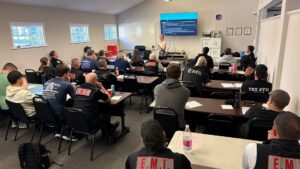
PrideStar Medical Director, Dr. Mollie Quipp, teaches one of the many training courses about the program to BLS personnel. (Photo courtesy PrideStar Trinity EMS)
LOWELL – PrideStar Trinity EMS, in collaboration with the City of Lowell, is preparing to launch an innovative prehospital buprenorphine program that will allow specially trained Basic Life Support (BLS) personnel to administer the medication to eligible patients experiencing opioid withdrawal following an overdose.
The initiative received an important boost this past Tuesday night when the Lowell City Council unanimously approved the use of funding from the Massachusetts Municipal Opioid Abatement Funds to support the buprenorphine initiative along with additional opioid awareness, prevention, harm reduction, treatment and recovery programs throughout the city. Once implemented, PrideStar Trinity EMS is expected to become the only BLS emergency ambulance service in Massachusetts utilizing buprenorphine as part of its prehospital response to opioid-related emergencies.

The program represents the latest step in a longstanding collaboration between PrideStar Trinity EMS, the City of Lowell, Lowell’s Department of Health and Human Services, the Lowell Board of Health, Riverbend and Lowell General Hospital to address the opioid crisis and connect individuals with treatment and recovery resources.
“This is about meeting people at a critical moment and giving our EMTs another tool that can potentially change the direction of someone’s life,” said David T. Daly, President of PrideStar Trinity EMS. “We have seen firsthand the devastating impact the opioid epidemic has had on individuals, families and our community. We are proud to work alongside the City of Lowell and our healthcare partners, and we thank the City Council for its unanimous support and continued commitment to finding new ways to address the opioid crisis.”

Since January 2011, PrideStar Trinity EMS data shows just under 8,000 opioid-related 911 incidents in Lowell. Those emergencies have occurred throughout the city and have aƯected people from a wide range of backgrounds.
Lowell has already developed a multifaceted response to the opioid crisis that includes community opioid outreach, the Mayor’s Opioid Task Force, participation in the District Attorney’s Opioid Task Force, real-time FirstWatch monitoring and collaboration with Lowell General Hospital. The new buprenorphine initiative builds upon those efforts.
 Naloxone, commonly known by the brand name Narcan, can rapidly reverse the potentially fatal effects of an opioid overdose. However, patients may subsequently experience acute opioid withdrawal, including nausea, body aches, anxiety and other significant symptoms. Those symptoms can contribute to some patients declining additional emergency medical care.
Buprenorphine can alleviate symptoms associated with acute opioid withdrawal and provide an important bridge toward continued treatment. Research reviewed as part of the program’s development indicates patients receiving prehospital buprenorphine can be significantly more likely to remain engaged in treatment 30 days later.

“The opioid epidemic has required all of us to continually look for new and more effective ways to reach people and connect them with the care and support they need,” said Lisa Golden, Director of Health and Human Services for the City of Lowell. “This program is a great example of what can happen when public health, emergency medical services, healthcare providers and city government work together. By bringing treatment directly to patients during a critical window, we have another opportunity to help someone take that next step toward recovery.”
Under the proposed protocol, eligible adult patients experiencing signs and symptoms of opioid withdrawal would be evaluated using established clinical criteria. Patients must consent to treatment before receiving buprenorphine.
 The program also includes defined exclusion criteria and ongoing clinical oversight. Every administration of buprenorphine will be reviewed by PrideStar Trinity EMS’ Medical Director, Clinical Supervisor and project leadership, along with Lowell General Hospital Addiction Medicine. Potential cases in which treatment may have been appropriate but was not administered will also undergo review as part of the program’s quality-assurance process.
The program will be funded entirely through Massachusetts Municipal Opioid Abatement Funds, which are restricted for uses related to opioid prevention, harm reduction, treatment and recovery. Massachusetts’ opioid settlement distributions are providing municipalities with dedicated resources to address the impact of the opioid epidemic.
 Lowell is scheduled to receive approximately $3.86 million between 2023 and 2039, including approximately $243,937 in Fiscal Year 2027.
“This is exactly the type of collaboration these funds were intended to support,” Said Jon Kelley, Director of Communications & Dispatch of PrideStar Trinity EMS. “By bringing together public health, medicine and EMS, we have another opportunity to help patients move from surviving an overdose toward treatment and recovery.”