This week’s Lowell City Council agenda echoes Elections Director Will Rosenberry’s preferred Special Election date to replace District 1 councilor Danny Rourke, while also revealing the potential cost of purchasing and rehabbing the Senior Center on Broadway Street.

On the Tuesday September 29th edition of the Daily Pulse Podcast, Rosenberry indicated he would like to see the council set December 15, 2026 as the date, the earliest possible date in the 64-120 day timeline required by law. While a vote still has to be taken to make the election calendar official, it appears the council agrees with the Elections Director’s recommendation:
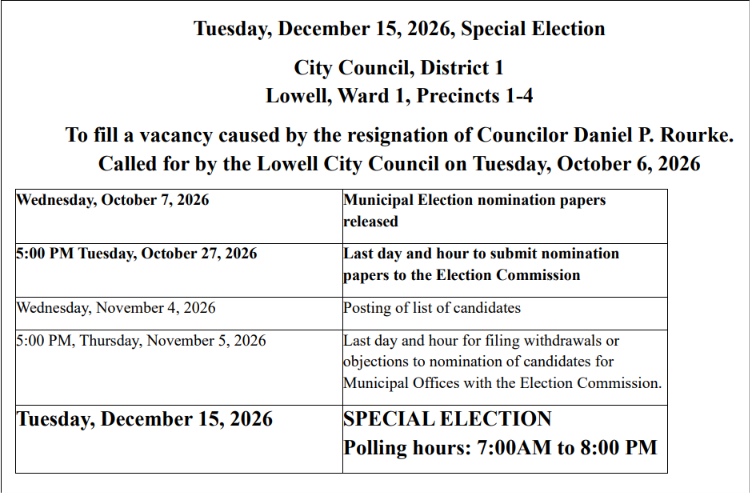
Interesting to note that if this calendar is approved, and we have no reason to believe it won’t be, nomination papers will become available the following day, Wednesday October 7.
To this point, only two candidates have publicly expressed interest in seeking the Pawtucketville neighborhood seat, Ray Boutin and Rodney Elliott.
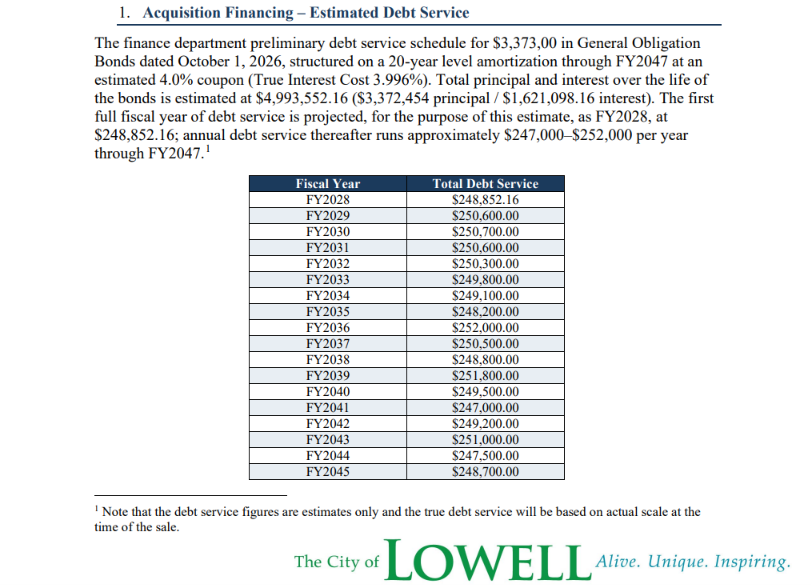
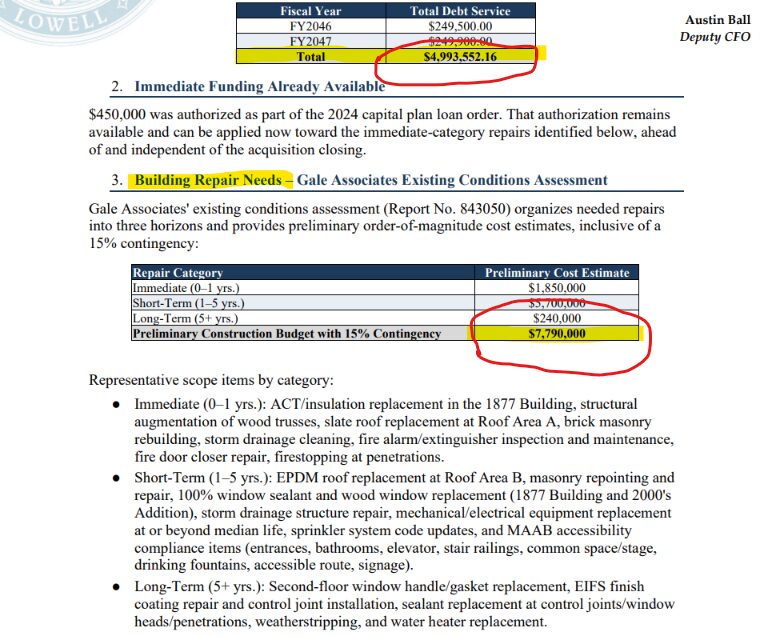
Meanwhile, after dominating the political discourse earlier this year, the Senior Center is back in the spotlight with a loan order request authorizing the City Manager to spend more than $11-million dollars to purchase the property and fund necessary repairs spelled out by Gale Associates, a consulting engineering firm. That figure climbs to nearly $13-million dollars, $12,783,552 to be exact, when interest payments are added to the $3,372,454 purchase price.
Interestingly, the Loan Order gives the City Manager the authority to acquire the property “by purchase, gift, eminent domain, or otherwise,” though it’s hard to imagine that numerous executive session discussions by the council and negotiations between the parties haven’t led to some type of understanding of the numbers required to make an agreeable purchase work without engaging in an adversarial eminent domain taking, a la the former dentist’s offices that became part of the Lowell High School construction project.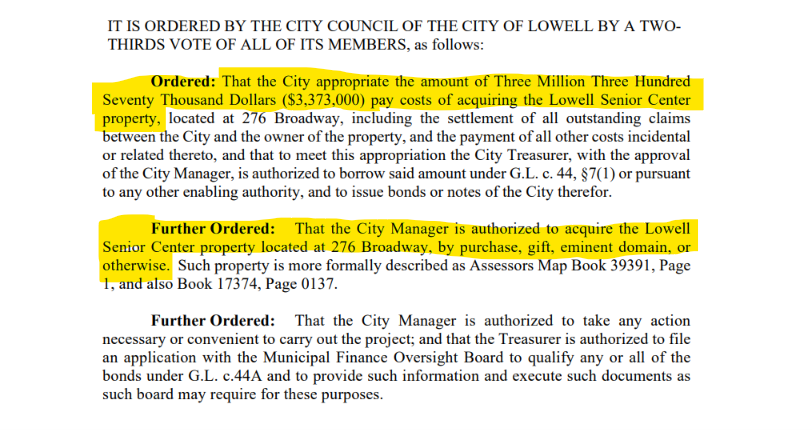 Hopefully, the discussion on the council floor will also answer the question of why and how this agreement was deemed more beneficial to taxpayers than the negotiated deal shot down by the council earlier this year.

That agreement called for the city to continue leasing the property for a period of 15-years at an annual rate of $504,000, amounting to a cost of $7,560.000, after which ownership would transfer to the city.
Under that scenario, Lowell could have used federal money from the Community Development Block Grant (CDBG) program to cover the rent, instead of the city’s taxpayers fully funding the purchase price, debt service, repairs and maintenance.
 Complicating the debate at the time was the property owner reneging on a 2001 lease agreement that would have turned the property over to the city after 20-years. No explanation has been publicly provided for why the agreed upon transfer never took place, and many councilors publicly questioned why the city would continue t0 pay rent on a building it “owned.”
Solicitor Corey Williams maintained language in the recorded deed did not give the city ownership of the property and that a court battle was likely to fail, an opinion backed up by local real estate attorney Christa Emerson during a Daily Pulse podcast in late February.
Given the fact this same governing body now stands poised to vote on buying the property in question, it appears the debate over who legally owns it has been answered.