
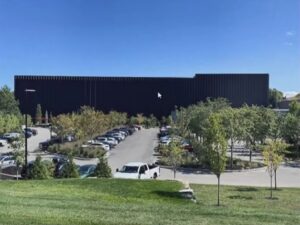
 A Superior Court Judge handed the litigants challenging Lowell’s Data Center and the Massachusetts Department of Environmental Protection (DEP) a victory today, issuing a “stay” against the Air Permit issued the Markley Group by the DEP.
In his ruling, Justice C. William Barrett ruled in favor of the plaintiffs’ motion, “but only with respect to the four backup diesel generators that have not yet been installed.”
He went on to write that “Markley is permitted to operate the four generators it installed previously, subject to the special conditions the Air Permit imposes.” (Link to today’s full ruling)
In all, Markley had previously received Air Permits for 19-backup generators. They then applied for eight more in an effort to bring the total to 27. It is these most recent generators Judge Barrett’s ruling today touches upon.
The data center’s expansion has been at the heart of a contentious political debate in the Mill City, one that mirrors the national battle over these facilities and their rapid expansion due to the demands of Artificial Intelligence.

Up to this point, the group of Lowell citizens fighting Markley had been unsuccessful in derailing the data center’s plans to grow their operation, despite vocal opposition from elected officials, residents and activist groups.
In a ruling issued July 10, 2026, DEP Commissioner Bonnie Heiple denied the citizen group’s appeal of an earlier agency ruling that upheld the granting of Air Permits. In that decision, Heiple wrote the “Petitioners have failed to demonstrate that the Final Decision was based on a finding of fact or ruling of law that was clearly erroneous, and they have otherwise renewed claims or arguments that were previously raised, considered and denied.” (Link to Heiple’s July ruling)

In issuing today’s stay, however, Judge Barrett ruled that potential harms to the plaintiffs, “far outweigh any harm to Markley, particularly where Markley does not utilize all of the backup generators they currently have. Markley also has not shown that it would be unable to function if the court were to preserve the status quo,” he wrote.


















8 responses to “Court Rules Against Markley and DEP on Backup Generators”
Lowell prided itself in becoming the frontrunner city of the US and this is quite the opposite. This is a statement saying that Lowell’s citizens don’t want to embrace new technologies and growth. This will for sure deter future businesses from coming to Lowell. The downfall has begun
At this point I think Lowell is sending the wrong signals to industry that may want to come here. A recent poll by WCVB shows 47% don’t even want to discuss it, they just want it gone.
“Markley Group makes record requests”:
https://www.lowellsun.com/2026/08/12/markley-group-makes-record-
requests/
Once again, this is what happens when justified grassroots citizen advocacy collides with high-stakes corporate development. But, there are legal frameworks in place that protect BOTH public participation and municipal government.
For private citizens, organizing and advocating legitimate concerns regarding ANY and ALL industrial expansions, there is the Massachusetts “anti-SLAPP” statute (MGL c. 231, section 59H). This serves as an absolute protective shield that gives legitimate petitioning and advocacy activities such as emailing local officials, calling, texting or filing environmental lawsuits “immune from retaliatory civil liability and shifting all defense costs to the corporation if a meritless intimidation lawsuit is filed”.
Furthermore, while ANY and ALL corporate tactics may include sweeping public records requests targeting municipal communications to uncover resident and citizens strategy, and while those communications are public record, the “anti-SLAPP” framework ensures that simply engaging with local leaders remains a legally Protected right.
Simultaneously, while public officials face conditional personal protection depending on whether they are sued in an official capacity (where they are fully indemnified by the municipality under MGL c. 258, section 9) or an individual capacity, the city itself must defend its legislative/zoning actions in a different arena.
Surviving aggressive and intimidating corporate lawsuits challenging newly enacted ordinances, Lowell can’t just rely on “anti-SLAPP” motions, instead, the local Board of Health must construct an unassailable record by “grounding its regulations in objective, documented public health data”, like independent sound studies, safety, health issues and ensuring uniform enforcement across ALL local commercial/business infrastructures. This will provide and prove that Lowell is executing a valid, industry-neutral policy of general applicability to safeguard the city, city wide.
The cars that come with ADUs and multi-family housing have more of a carbon footprint and more dangerous emissions than a handful of generators that only run during a power outage. But let’s not focus on facts or science when we can yell instead.
14 acres with 27 generators = 2 generators per acre.
27 generators limited to 70 hours running time per year by law = <140 generator hours per year per acre (maximum)
The exact legal playbook needed to protect both the neighborhood and the city is the Lowell Board of Health. They hold the ultimate “Wildcard” here because under M.G.L. c. 111, section 31 and section 143, the Board has broad independent statutory power to prevent public health nuisances.
By bypassing standard zoning grandfathering loopholes and establishing a data-driven, industry-neutral health ordinance backed by independent sound and safety studies, the city can enact a policy of general applicability that holds ALL commercial/business infrastructure to the same standard, effectively safeguarding our neighborhoods, city-wide.
Possible Motion???: Request the City Manager direct the City Solicitor and the Law Department to evaluate and draft a dual-track municipal regulatory framework modeled after established Massachusetts municipal standards; first, by drafting an industry-neutral general city ordinance establishing utility power demand thresholds based on public safety, grid reliability, and municipal infrastructure capacity; and second, by coordinating with the Board of Health, drafting environmental health regulations under the statutory authority of the Board of Health pursuant to M.G.L. c. 111, sections 31, 122, and 143, ensuring strict alignment with the Mass DEP Noise Policy guidelines, low frequency vibration criteria and public nuisance prevention standards; provided further that BOTH tracks shall fulfill the city’s obligations under the Commonwealth’s Environmental Justice policies, and shall utilize independent, data-driven studies to create a legally defensible standard that safeguards and protects the quality of life in ALL Lowell neighborhoods.
Lowell can protect ALL its neighborhoods by putting the new rules into two different city tracks at the same time, General City Ordinances and Board of Health Regulations.
FYI:
Under the Massachusetts Public Records Law (MGL c. 66, section 10), the City of Lowell is LEGALLY EMPOWERED to protect its HARDWORKING TAXPAYERS’ budget by shifting the entire financial burden of this MASSIVE 2-YEAR request back onto Markley. Because Markley is a commercial entity, the city can charge for the actual time city employees spend searching, compiling, and segregating files, “capped at the hourly rate of the lowest paid worker capable of performing the task (up to $25 per hour)”.
Furthermore, because the BIG, HUGE task targets highly sensitive communications surrounding an active lawsuit, the city can petition the state Supervisor of Records to charge a higher hourly rate for the specialized legal review needed to redact privileged information. To ensure the city DOESN’T SPEND A SINGLE DIME upfront, the City’s “Records Access Officer”, working along with the Law Department, can issue an itemized “Good-Faith Estimate” to Markley’s law firm, Choate, and the city is FULLY AUTHORIZED to DEMAND FULL PAYMENT of this total before even pulling a single email, text message, or written correspondence from January 1, 2024, to the present!
To understand what happened last night at the Lowell Planning Board mtg.(8/17/26), it’s simple, Markley’s sudden push to build a new road layout was a calculated legal maneuver. Under Massachusetts General Law (M.G.L. c. 40A, section 6), if a developer submits a definitive subdivision plan showing a new proposed road, it triggers an automatic one-year zoning freeze. Markley doesn’t care about the road itself. They care about the statutory protection that filing provides.
The exact day they submitted that plan, the zoning rules for that land locked in for 12 months. Markley’s elite lawyers at Choate will now argue that the city’s 360-day data center moratorium cannot retroactively touch this land because the road plan legally “froze” the old, favorable industrial zoning rules in place.
So, who dropped the Ball? Let’s be fair and reasonable here, the Planning Board members are unpaid citizen volunteers who rely entirely on the full-time, paid municipal staff to track legal traps. Last night, the ball was dropped squarely by the city’s administrative leadership because the statutory clock under M.G.L. c. 41, section 81U, the Planning Board faces a strict 135day deadline to file a final decision. Staff failed a timely vote or lock down a formal, written extension before last night’s mtg., stripping the board of its leverage and failed to guard the gate.
WE all know Markley is highly litigious, and the City Solicitor’s office should have forced an extension agreement before the meeting even began. Instead, they let the clock run out. A BIG, HUGE administrative failure, because a simple motion to continue for a site walk would have triggered an unconditional “Constructive Approval”, giving Markley a completely unrestricted blank check! To prevent that, the Planning Board scrambled on the fly to pass an approval with weak, administrative conditions like storm water and wetlands reviews, working with the sustainability director, etc., just to save face. The administration fell asleep at the switch, and the poor neighborhood, the hardworking taxpayers paid the price on the zoning front.
BTW, did you all notice what was missing in those conditions? There was absolutely nothing protecting public health. A storm water report does not stop 24/7 low-frequency noise. A wetlands review does not stop toxic soil dust or protect neighborhood sleep cycles, leaving the neighborhood entirely unprotected.
Guess what, nuisance laws trump zoning and even though Markley won over a road layout, they did not win the health battle. Why, because a conditional zoning approval does not grant a corporation license to pollute or violate public noise standards. So because of this, now the neighborhood has to abandon the Planning Board track and get behind Plan B, The Lowell Board of Health and M.G.L. c. 111, sections 31,122 and 143.
In Massachusetts, zoning grandfathering NEVER applies to a public health nuisance. Markley might have permission to divide a piece of land, but they do not have a license to make neighbors sick or destroy residential property equity. The Board of Health holds supreme, autonomous statutory authority to regulate and shut down public nuisances, regardless of any zoning freezes.
Moving forward, what WE need now more than ever are MEDICAL EXPERTS. This fight is too critical to be managed by people chasing political ambition. The Board of Health must be a scientific protective shield for ALL the neighborhoods and the WHOLE community, not a steppingstone and springboard for someone’s political career, leaving neighborhoods unprotected. WE need ALL medical experts on the Lowell Board of Health. Licensed doctors, nurses, and public health toxicologists and public health scientists qualified to look at data, human biology, and environmental toxins. That actually care about sleep cycles, cortisol levels, and clean air, not their political campaign, contributions or television camera angles.
An elite corporate lawyer cannot easily intimidate or gaslight a knowledgeable and highly educated medical professional who deeply understands the biological, physiological and psychological damage caused by low-frequency noise pollution and diesel emissions. The hardworking taxpayers have a legal right to order independent, developer-funded sound and soil studies, and enforce a zero-tolerance low-frequency vibration threshold. This is a medical and environmental necessity, a public health crusade, NOT a political game! People, Pivot to the Lowell Board of Health!
LOWELL CITY COUNCIL MEETING AUGUST 24, 2026
(Motion 5.2 C. McDonough – Req. City Mgr. determine the feasibility of, and at his discretion take, legal action, including the right of to appeal under MGL 40 S 81BB, to enforce ordinance, policy, and other regulation of the city of Lowell pertaining to permitting, subdivision of land, or any other matter subject to approval by local land use boards.)
While the motion I believe is well intended, it ultimately will face an uphill battle in court because its not a legal fix. Seriously, are you asking the city to sue itself? Lets face it, the Planning Board at that August 17th mtg. was legally trapped! They did all they could by acting defensively and protecting the city from a TOTAL loophole!
(Motion 5.3 C. McDonough – Req. City Mgr. work with the appropriate departments to provide the council with a report on all available options, including those granted to the Board of Health by MGL 111 S 31C, regarding regulation of industry within the city of Lowell; said report should include local options for water use, fuel storage and electrical infrastructure; as well as air, noise, light, and water pollution and potential public health impacts.)
Now THIS motion is highly viable because it pivots to public health and environmental health laws and regulations, which is the game changer. But, you must make sure you have medical and environmental experts on that Board of Health. BTW, the Lowell City Council is NOT evading its responsibility by passing the ball to the Lowell Board of Health! They are the only legislative, legal authority and option the city has to override ANY developers zoning protections. Right now, the Lowell Board of Health controls the ball that can actually win the game! Why, because PUBLIC HEALTH TRUMPS ZONING!
(Motion 5.4 C. McDonough – Req. City Mgr. work with the proper department to provide the council with a summary of MGL CH 268A as it pertains to any former city councilor appearing before the council on behalf of a client; said report should consider a hypothetical situation in which the client had business before the council when the former councilor was a member.
Legally, this is not viable because the Attorney in question no longer represents Markley. Plus, to investigate a “hypothetical situation” involving a former Lowell City Councilor will accomplish NOTHING and is a TOTAL WASTE of the HARDWORKING TAXPAYERS TIME and MONEY! Why, because it will be a TOTAL DRAIN to the already stressed departments already impacted by the MASSIVE budget cuts. This motion is basically political grandstanding and will drain even more vital city resources at a time when the city can least afford it. Plus, it offers absolutely NO legal remedies or protections.